





Breaking Boundaries to Develop Hong Kong into a Mega Sports Events Capital (2025)




Breaking Boundaries to Develop Hong Kong into a Mega Sports Events Capital (2025)

Our Hong Kong Foundation (OHKF) launched its latest research report titled “Breaking Boundaries to Develop Hong Kong into a Mega Sports Events Capital.” The report emphasises that Hong Kong athletes have continued to shine on the international stage, making history in recent years and achieving unprecedented success by winning gold medals in two consecutive Olympic Games, sparking a wave of enthusiasm for sports development in the society. However, to truly realise the vision of becoming the “mega sports events capital”, Hong Kong must overcome existing limitations.
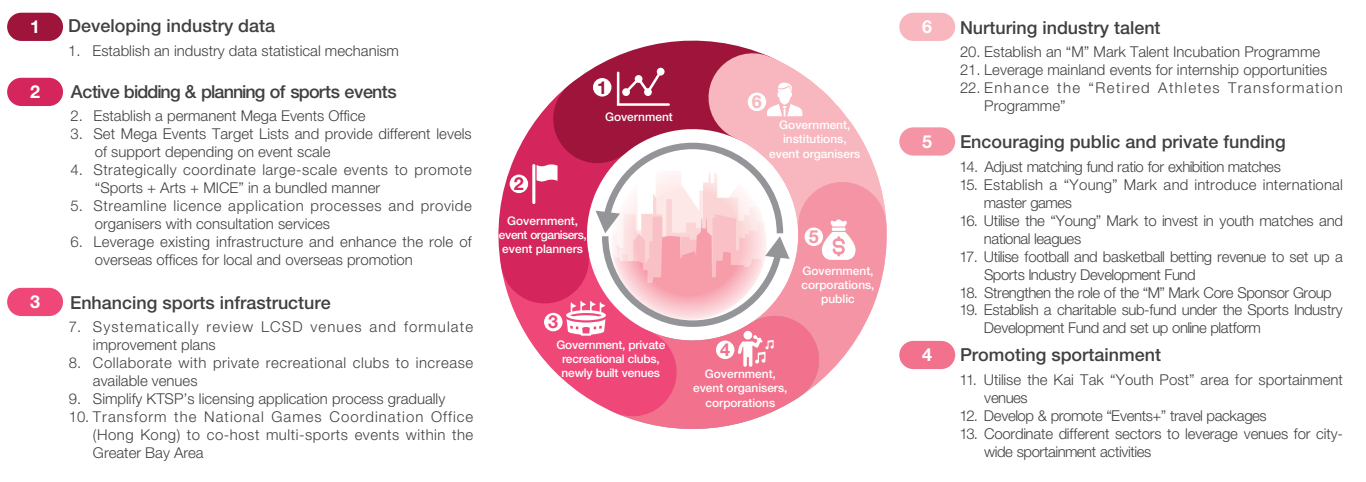
The report puts forward a total of 22 policy recommendations across six key aspects to promote the comprehensive development of the sports industry through mega sports events: (i) developing industry data, (ii) active bidding and planning of sports events, (iii) enhancing sports infrastructure, (iv) promoting sportainment, (v) encouraging public and private funding, and (vi) nurturing industry talent. The recommendations are as follows:
(i) Developing industry data
Establish an industry data statistical mechanism: The Culture, Sports and Tourism Bureau (CSTB) should establish an industry data mechanism, seconding statisticians from the Census and Statistics Department (C&SD) to establish internal data statistician positions and commissioning third-party organisations to conduct research on the sports industry. The mechanism should quantify industry size and capture the multiplier effects of mega sports events.
(ii) Active bidding & planning
Establish a permanent Mega Events Office: The Office should coordinate and plan at a higher level. This includes setting Mega Events Target Lists with the industries, strategically coordinating large-scale events to promote “Sports + Arts + Meetings, Incentives, Conventions, and Exhibitions (MICE)” in a bundled manner, coordinating governmental departments and various community sectors, providing event organisers with consultation services, and reviewing and simplifying the licence application process. These measures will boost the confidence of organisers in hosting events in Hong Kong.
(iii) Enhancing sports infrastructure
Optimise the utilisation of venue resources: Systematically review LCSD venues and formulate improvement plans for major venues. Collaborate with private recreational clubs to increase available venues for sports events and related activities. At the same time, the government should consider streamlining the licensing application process for newly constructed sports venues (such as the Kai Tak Sports Park) to attract more major events to Hong Kong. Following the National Games, the National Games Coordination Office (Hong Kong) could be transformed into a permanent institution to actively co-host more regional and global sporting events.
(iv) Promoting sportainment
Promote sports tourism: Utilise the Kai Tak “Youth Post” hostel Area to develop sportainment venues. In addition, the Mega Events Office should coordinate with industries to develop “Events+” packages to integrate various sports, cultural, and travel activities. Furthermore, facilitate greater use of venues by the Government, District Councils, community and business sectors, for promotional activities to drive city-wide engagement.
(v) Encouraging public & private funding
Adjusting public funding: The government could consider adjusting the matching fund ratio for “M” Mark exhibition matches to a 1:1 government–corporate ratio. In addition, the government could establish a “Young” Mark to invest in innovative and emerging events, including master games, youth matches and national professional leagues, to fully realise their social and economic benefits. The matching fund ratio for international master tournaments could be set at 1:1, while the ratio for international youth competitions and national leagues could be set at 7:3. Additionally, the Government and the Jockey Club could each allocate funds through basketball and football betting revenues to establish a more flexible Sports Industry Development Fund, expanding the sources of funding for major events.
Encourage private funding: Strengthen the role of the “M” Mark Core Sponsor Group, including hosting regular seminars and providing sponsorship negotiation workshops for NSAs, turning the Core Sponsor Group into a regular platform to promote cooperation between sports associations and potential sponsors. In addition, the Government could establish a tax-deductible charity sub-fund could encourage public contributions to support the development of the sports industry, fostering a culture of public engagement in the sports industry.
(vi) Nurturing Industry Talent
Nurturing talent via mega events: For students, the government could establish an “M” Mark Events Talent Incubation Programme to fund event organisers or contractors to hire interns for roles in event planning, public relations, marketing, and venue management, and could introduce sports events internships under the Home and Youth Affairs Bureau’s Thematic Youth Internship Programmes. For retired athletes, CSTB could expand the scope of the “Retired Athletes Transformation Programme” to encourage event-related organisations to employ retired athletes in full-time, short-term or part-time event-related roles.
Through the concerted efforts of the Government, industry and societal sectors, Hong Kong has the potential to achieve groundbreaking development in the mega sports events economy and help secure Hong Kong’s status as a “mega sports events capital”.




Our Hong Kong Foundation (OHKF) launched its latest research report titled “Breaking Boundaries to Develop Hong Kong into a Mega Sports Events Capital.” The report emphasises that Hong Kong athletes have continued to shine on the international stage, making history in recent years and achieving unprecedented success by winning gold medals in two consecutive Olympic Games, sparking a wave of enthusiasm for sports development in the society. However, to truly realise the vision of becoming the “mega sports events capital”, Hong Kong must overcome existing limitations.
The report puts forward a total of 22 policy recommendations across six key aspects to promote the comprehensive development of the sports industry through mega sports events: (i) developing industry data, (ii) active bidding and planning of sports events, (iii) enhancing sports infrastructure, (iv) promoting sportainment, (v) encouraging public and private funding, and (vi) nurturing industry talent. The recommendations are as follows:
(i) Developing industry data
Establish an industry data statistical mechanism: The Culture, Sports and Tourism Bureau (CSTB) should establish an industry data mechanism, seconding statisticians from the Census and Statistics Department (C&SD) to establish internal data statistician positions and commissioning third-party organisations to conduct research on the sports industry. The mechanism should quantify industry size and capture the multiplier effects of mega sports events.
(ii) Active bidding & planning
Establish a permanent Mega Events Office: The Office should coordinate and plan at a higher level. This includes setting Mega Events Target Lists with the industries, strategically coordinating large-scale events to promote “Sports + Arts + Meetings, Incentives, Conventions, and Exhibitions (MICE)” in a bundled manner, coordinating governmental departments and various community sectors, providing event organisers with consultation services, and reviewing and simplifying the licence application process. These measures will boost the confidence of organisers in hosting events in Hong Kong.
(iii) Enhancing sports infrastructure
Optimise the utilisation of venue resources: Systematically review LCSD venues and formulate improvement plans for major venues. Collaborate with private recreational clubs to increase available venues for sports events and related activities. At the same time, the government should consider streamlining the licensing application process for newly constructed sports venues (such as the Kai Tak Sports Park) to attract more major events to Hong Kong. Following the National Games, the National Games Coordination Office (Hong Kong) could be transformed into a permanent institution to actively co-host more regional and global sporting events.
(iv) Promoting sportainment
Promote sports tourism: Utilise the Kai Tak “Youth Post” hostel Area to develop sportainment venues. In addition, the Mega Events Office should coordinate with industries to develop “Events+” packages to integrate various sports, cultural, and travel activities. Furthermore, facilitate greater use of venues by the Government, District Councils, community and business sectors, for promotional activities to drive city-wide engagement.
(v) Encouraging public & private funding
Adjusting public funding: The government could consider adjusting the matching fund ratio for “M” Mark exhibition matches to a 1:1 government–corporate ratio. In addition, the government could establish a “Young” Mark to invest in innovative and emerging events, including master games, youth matches and national professional leagues, to fully realise their social and economic benefits. The matching fund ratio for international master tournaments could be set at 1:1, while the ratio for international youth competitions and national leagues could be set at 7:3. Additionally, the Government and the Jockey Club could each allocate funds through basketball and football betting revenues to establish a more flexible Sports Industry Development Fund, expanding the sources of funding for major events.
Encourage private funding: Strengthen the role of the “M” Mark Core Sponsor Group, including hosting regular seminars and providing sponsorship negotiation workshops for NSAs, turning the Core Sponsor Group into a regular platform to promote cooperation between sports associations and potential sponsors. In addition, the Government could establish a tax-deductible charity sub-fund could encourage public contributions to support the development of the sports industry, fostering a culture of public engagement in the sports industry.
(vi) Nurturing Industry Talent
Nurturing talent via mega events: For students, the government could establish an “M” Mark Events Talent Incubation Programme to fund event organisers or contractors to hire interns for roles in event planning, public relations, marketing, and venue management, and could introduce sports events internships under the Home and Youth Affairs Bureau’s Thematic Youth Internship Programmes. For retired athletes, CSTB could expand the scope of the “Retired Athletes Transformation Programme” to encourage event-related organisations to employ retired athletes in full-time, short-term or part-time event-related roles.
Through the concerted efforts of the Government, industry and societal sectors, Hong Kong has the potential to achieve groundbreaking development in the mega sports events economy and help secure Hong Kong’s status as a “mega sports events capital”.