







Technology and Innovation Report 2025: Inclusive Artificial Intelligence for Development




Technology and Innovation Report 2025: Inclusive Artificial Intelligence for Development

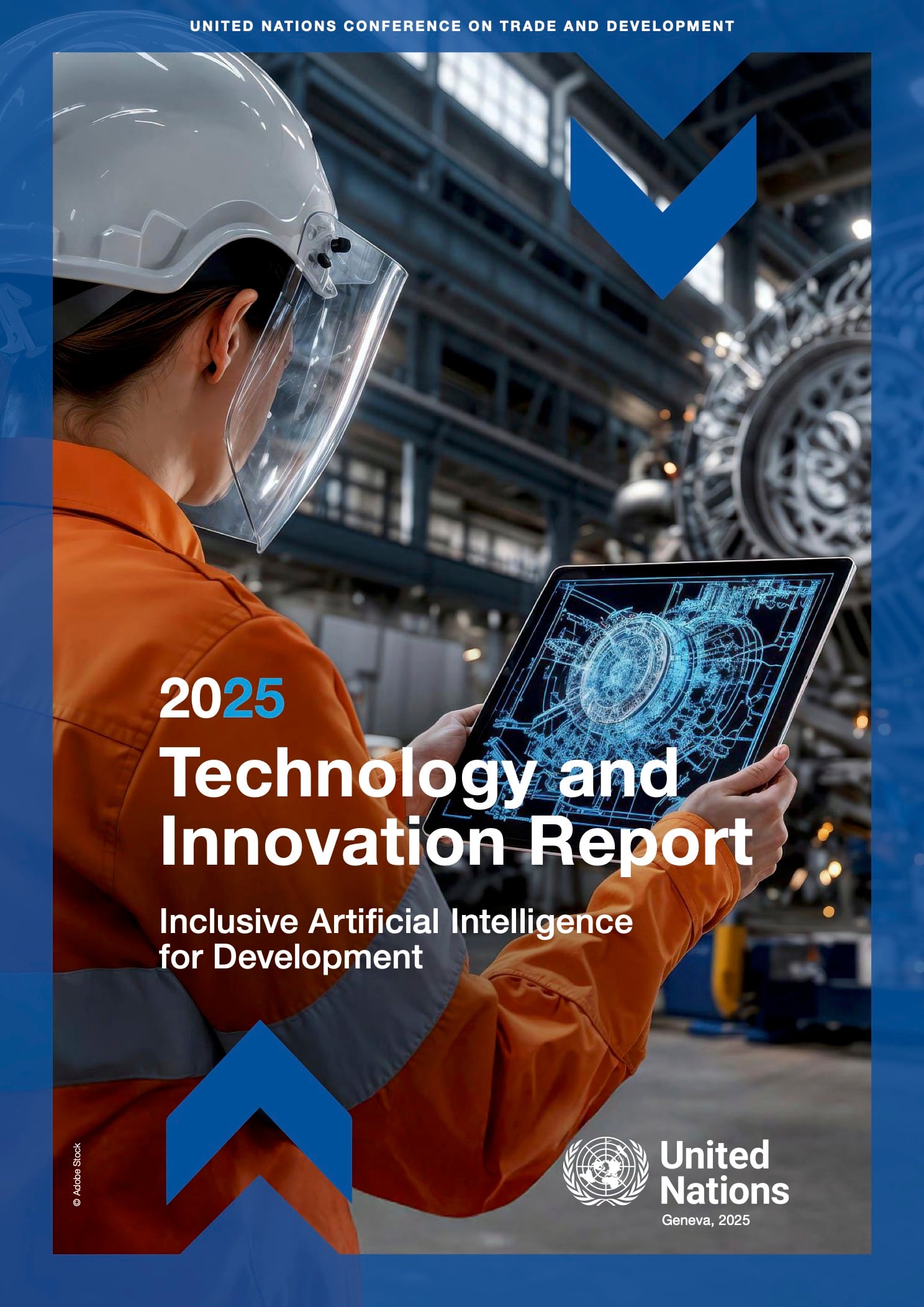
Artificial intelligence (AI) technology is rapidly reshaping global economic structures and work patterns. UN Trade and Development (UNCTAD) published its 2025 Technology and Innovation Report: Inclusive Artificial Intelligence for Development (the report) this year. Our Hong Kong Foundation (OHKF) was honoured to have participated in the writing of the report. We also funded and were responsible for translating the report into Chinese.
The report explores the complex global landscape of AI development, conducts a multidimensional analysis of regional preparedness for AI adoption and development, explains how science, technology, and innovation (STI) policies can help economies at different stages of development capture AI growth dividends, and concludes with a call for global cooperation to establish an international AI governance framework for shared prosperity.
Referencing multiple international studies, the report demonstrates that AI can significantly boost total factor productivity, a key driver of GDP growth, showing its substantial economic benefits. However, current AI Research & Development investment and infrastructure remain highly concentrated among a few economies and tech giants. Without policy support, AI development risks further exacerbating regional disparities in productivity and innovation.
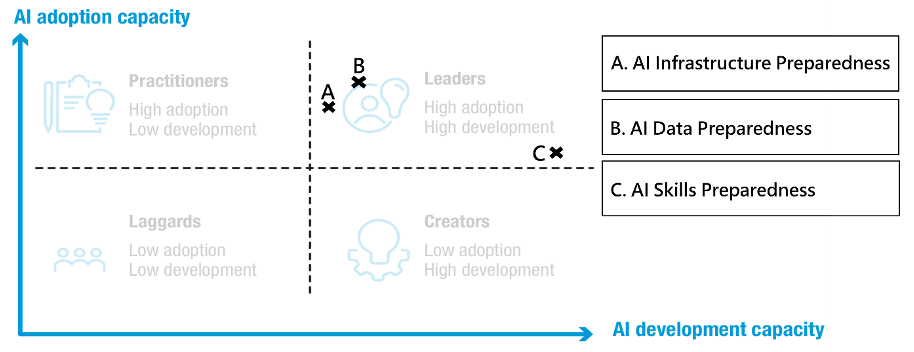
In addition, the report establishes a framework for evaluating AI preparedness based on three aspects: infrastructure, data, and skills. Each aspect can be analysed from two perspectives: AI adoption and development capacity, resulting in a matrix classification of “Practitioners,” “Leaders,” “Laggards,” and “Creators.” In the assessment of over 100 economies, Hong Kong was rated as a Leader in all three aspects—infrastructure, data, and skills—indicating that Hong Kong has achieved a high level of capacity in both adoption and development across these areas.
Meanwhile, according to the report, AI reshapes the labour market via four key channels. It includes (i) substituting human labour with higher efficiency; (ii) complementing human labour; (iii) deepening automation; (iv) creating new job opportunities. The actual benefits gained by different economies can vary significantly. This disparity is closely tied to the industrial structure in each region. Currently, the sectors most vulnerable to AI disruption are those heavily reliant on writing, analysis, and knowledge processing, such as finance, advertising, consulting services, and information technology. These roles constitute a higher proportion of employment in developed economies. Consequently, their labour markets face stronger pressure for technological substitution and transformation, while also being better positioned to leverage AI for efficiency gains, new business development, and higher value creation.
The report lastly calls for strengthened global cooperation to promote knowledge sharing; the establishment of international research partnerships to encourage technology transfer and capacity building; and the facilitation of exchanges among developing economies to jointly promote AI solutions. These efforts will ensure all nations can benefit from AI development.




Artificial intelligence (AI) technology is rapidly reshaping global economic structures and work patterns. UN Trade and Development (UNCTAD) published its 2025 Technology and Innovation Report: Inclusive Artificial Intelligence for Development (the report) this year. Our Hong Kong Foundation (OHKF) was honoured to have participated in the writing of the report. We also funded and were responsible for translating the report into Chinese.
The report explores the complex global landscape of AI development, conducts a multidimensional analysis of regional preparedness for AI adoption and development, explains how science, technology, and innovation (STI) policies can help economies at different stages of development capture AI growth dividends, and concludes with a call for global cooperation to establish an international AI governance framework for shared prosperity.
Referencing multiple international studies, the report demonstrates that AI can significantly boost total factor productivity, a key driver of GDP growth, showing its substantial economic benefits. However, current AI Research & Development investment and infrastructure remain highly concentrated among a few economies and tech giants. Without policy support, AI development risks further exacerbating regional disparities in productivity and innovation.
In addition, the report establishes a framework for evaluating AI preparedness based on three aspects: infrastructure, data, and skills. Each aspect can be analysed from two perspectives: AI adoption and development capacity, resulting in a matrix classification of “Practitioners,” “Leaders,” “Laggards,” and “Creators.” In the assessment of over 100 economies, Hong Kong was rated as a Leader in all three aspects—infrastructure, data, and skills—indicating that Hong Kong has achieved a high level of capacity in both adoption and development across these areas.
Meanwhile, according to the report, AI reshapes the labour market via four key channels. It includes (i) substituting human labour with higher efficiency; (ii) complementing human labour; (iii) deepening automation; (iv) creating new job opportunities. The actual benefits gained by different economies can vary significantly. This disparity is closely tied to the industrial structure in each region. Currently, the sectors most vulnerable to AI disruption are those heavily reliant on writing, analysis, and knowledge processing, such as finance, advertising, consulting services, and information technology. These roles constitute a higher proportion of employment in developed economies. Consequently, their labour markets face stronger pressure for technological substitution and transformation, while also being better positioned to leverage AI for efficiency gains, new business development, and higher value creation.
The report lastly calls for strengthened global cooperation to promote knowledge sharing; the establishment of international research partnerships to encourage technology transfer and capacity building; and the facilitation of exchanges among developing economies to jointly promote AI solutions. These efforts will ensure all nations can benefit from AI development.