








Strategic Purchasing: Enabling Health for All




Strategic Purchasing: Enabling Health for All

While ranked as one of the most efficient health systems globally, Hong Kong is currently facing a population ageing phenomenon and growing burden of chronic conditions. To strengthen the health system against these pressures, emphasis needs to be placed upon pivoting towards healthcare service provision in the community that is integrated across different levels of care, coordinated between specialties and providers, and interfaced with social care. This may be achieved in an integrated, person-centred, primary care-led health system (Figure 1).
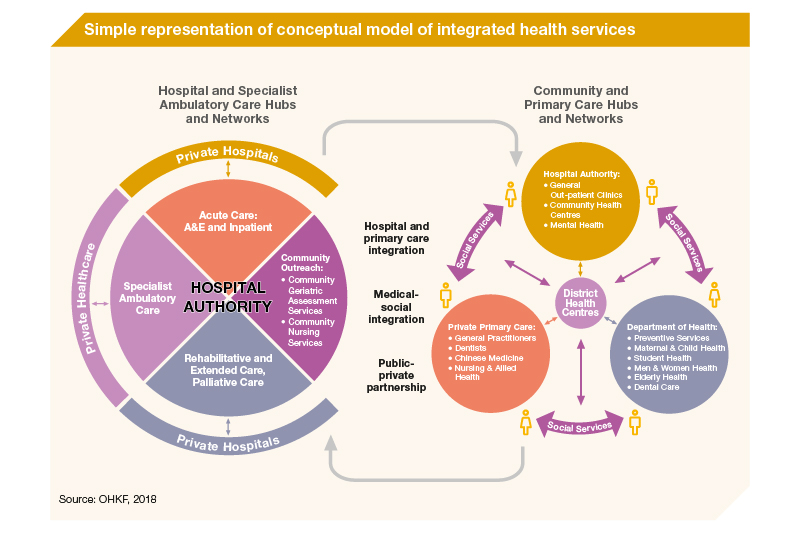
To achieve this new modality and ease the pressure on the public sector health system, it is critical to apply strategic purchasing as a critical health financing lever in governance and health service planning. Concurrently, Hong Kong must consider the use of public-private partnerships (PPPs) as a purchasing instrument to enable better allocation and utilisation of resources to meet population needs.
To illustrate the application of strategic purchasing and offer a path forward for developing primary healthcare in Hong Kong, we assessed the feasibility of a Chronic Disease Screening Voucher and Management Scheme (CDSVMS, also addressed as “Scheme”) for three prevalent targeted chronic conditions, namely hypertension, hyperglycaemia (diabetes), and hyperlipidaemia (collectively termed “HDH”) designed based on the perspectives gained from key stakeholders through interviews, and from citizens through a population-based telephone survey. We also projected the economic impact of this Scheme for Diabetes Mellitus (DM) on the health system over the course of 30 years for individuals aged 45 to 54 years of age at the start of the Scheme.
Our research shows that:
1) Stakeholders are supportive of measures to boost access to screening and management of chronic conditions via public-private partnerships designed based on strategic purchasing principles;
2) Over 75% of telephone survey respondents currently without a chronic condition would be willing to join the proposed Scheme;
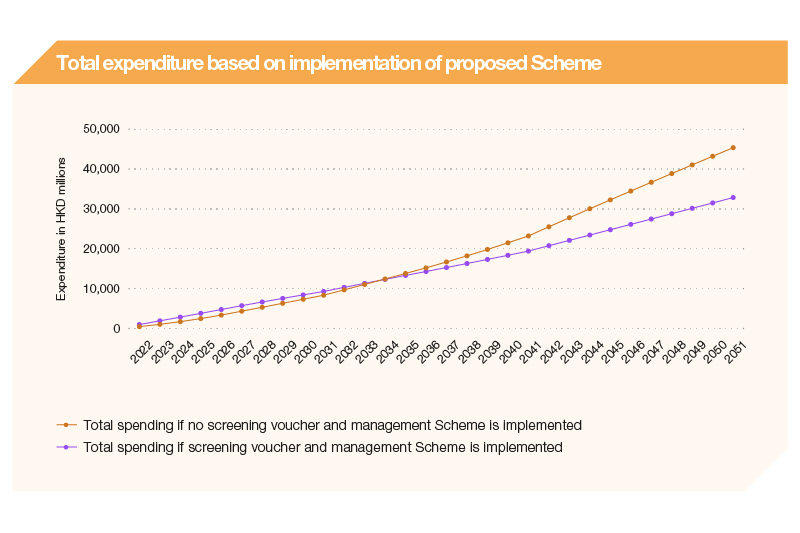
3) Implementing a screening voucher and management scheme would allow the health system to reduce its expenditures in relation to diabetes care (Figure 2); and
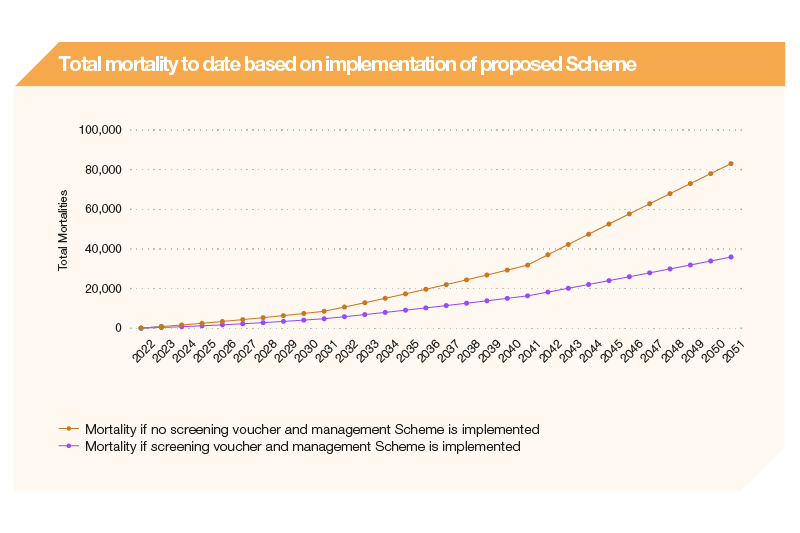
4) Participation in the Scheme will reduce the premature mortality count in relation to diabetes mellitus (Figure 3).
Based on this research, we present four key policy directions:
(1) Hong Kong should apply strategic purchasing and leverage public-private partnerships as a purchasing instrument with a strategic vision for improving primary care accessibility.
(2) Hong Kong should introduce a Chronic Disease Screening Voucher and Management Scheme to enhance primary care access for chronic disease, specifically hypertension, hyperglycaemia (diabetes), and hyperlipidaemia.
(3) The Government must apply key policy dimensions of strategic purchasing to the Scheme, which include: population health, citizen empowerment, strengthening government stewardship and capacity, developing effective purchaser and provider orgnaisations, and incorporating cost-effective contracting.
(4) Health system strategic purchasing should be implemented for achieving an integrated care system to enable health for all, across the health system level (macro), purchaser-provider healthcare delivery system (meso), and person journey of healthcare delivery (micro).




While ranked as one of the most efficient health systems globally, Hong Kong is currently facing a population ageing phenomenon and growing burden of chronic conditions. To strengthen the health system against these pressures, emphasis needs to be placed upon pivoting towards healthcare service provision in the community that is integrated across different levels of care, coordinated between specialties and providers, and interfaced with social care. This may be achieved in an integrated, person-centred, primary care-led health system (Figure 1).
To achieve this new modality and ease the pressure on the public sector health system, it is critical to apply strategic purchasing as a critical health financing lever in governance and health service planning. Concurrently, Hong Kong must consider the use of public-private partnerships (PPPs) as a purchasing instrument to enable better allocation and utilisation of resources to meet population needs.
To illustrate the application of strategic purchasing and offer a path forward for developing primary healthcare in Hong Kong, we assessed the feasibility of a Chronic Disease Screening Voucher and Management Scheme (CDSVMS, also addressed as “Scheme”) for three prevalent targeted chronic conditions, namely hypertension, hyperglycaemia (diabetes), and hyperlipidaemia (collectively termed “HDH”) designed based on the perspectives gained from key stakeholders through interviews, and from citizens through a population-based telephone survey. We also projected the economic impact of this Scheme for Diabetes Mellitus (DM) on the health system over the course of 30 years for individuals aged 45 to 54 years of age at the start of the Scheme.
Our research shows that:
1) Stakeholders are supportive of measures to boost access to screening and management of chronic conditions via public-private partnerships designed based on strategic purchasing principles;
2) Over 75% of telephone survey respondents currently without a chronic condition would be willing to join the proposed Scheme;
3) Implementing a screening voucher and management scheme would allow the health system to reduce its expenditures in relation to diabetes care (Figure 2); and
4) Participation in the Scheme will reduce the premature mortality count in relation to diabetes mellitus (Figure 3).
Based on this research, we present four key policy directions:
(1) Hong Kong should apply strategic purchasing and leverage public-private partnerships as a purchasing instrument with a strategic vision for improving primary care accessibility.
(2) Hong Kong should introduce a Chronic Disease Screening Voucher and Management Scheme to enhance primary care access for chronic disease, specifically hypertension, hyperglycaemia (diabetes), and hyperlipidaemia.
(3) The Government must apply key policy dimensions of strategic purchasing to the Scheme, which include: population health, citizen empowerment, strengthening government stewardship and capacity, developing effective purchaser and provider orgnaisations, and incorporating cost-effective contracting.
(4) Health system strategic purchasing should be implemented for achieving an integrated care system to enable health for all, across the health system level (macro), purchaser-provider healthcare delivery system (meso), and person journey of healthcare delivery (micro).