









Decisive Moment — Can Hong Kong Save Itself from the Land and Housing Supply Crisis?




Decisive Moment — Can Hong Kong Save Itself from the Land and Housing Supply Crisis?

On 21 April 2021, Our Hong Kong Foundation (OHKF) has released a new research report on Land and Housing policy entitled Decisive Moment — Can Hong Kong Save Itself from the Land and Housing Supply Crisis? The Report points out that Hong Kong is caught in a deadlock of “triple lows”, respectively in spade-ready land supply, housing completions, and quality of living. A Herculean effort is needed from the HKSAR Government to achieve the ten-year Long Term Housing Strategy (LTHS) housing supply target. The OHKF provides an exclusive ten-year forecast on public and private housing supply. We urge the Government to take immediate action by expediating all land supply initiatives and spare no effort in streamlining the approval processes for land and housing development.
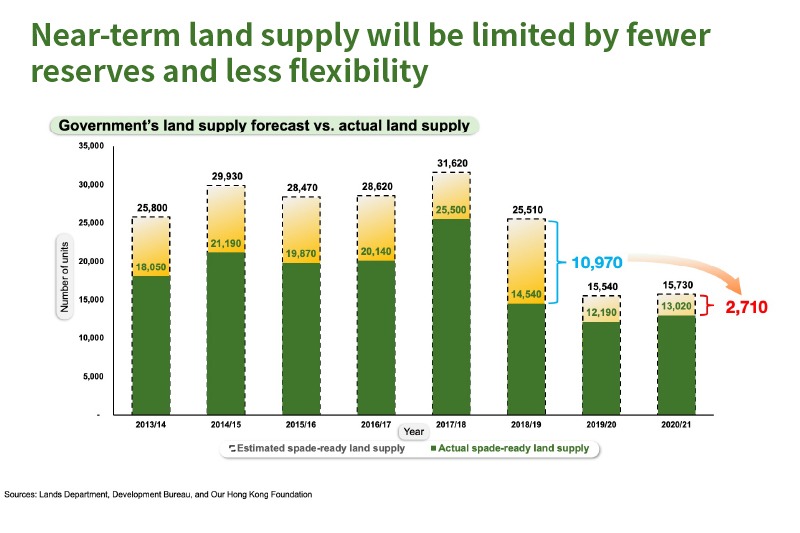
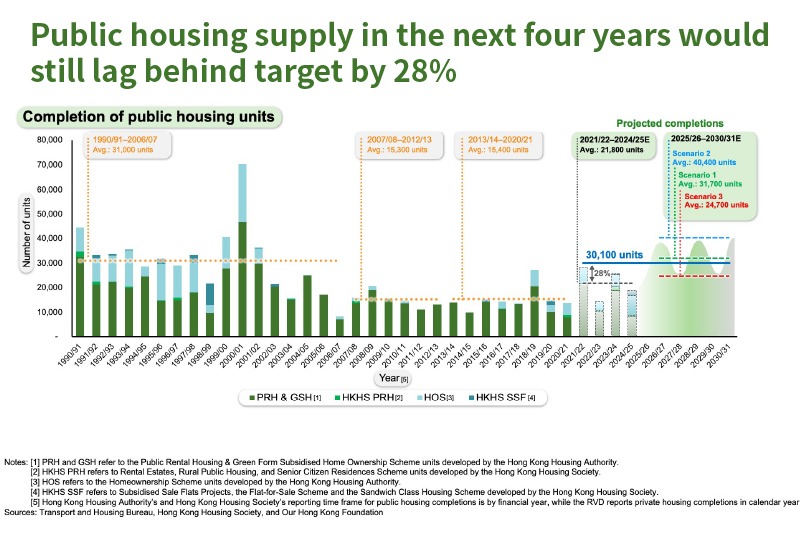
Hong Kong has been increasingly plagued by a lack of good-quality land for housing due to the lack of large-scale land development over the past 20 years, and the stock from existing new towns has been gradually exhausting. The Report cites the land available for private residential development as an example, with the supply falling from the peak level of 25,500 units recorded three years ago to 13,020 units this year. The report forecasts that the number of private residential completions in the next five years will average only approximately 15,000 units per year. This is 28% lower than the 20,900 units completed last year. Public housing supply in the next four years is also expected to lag behind the LTHS target by 28%, with an annual average of 21,800 units. The shortage in supply will also cast a negative light on the quality of living, as Hong Kong people will suffer from the consequence of living in smaller and more expensive flats. It is predicted that the average gross floor area of newly completed private housing units will continue to shrink to less than 600 square feet in 2024, almost one-third smaller than in 2012 (which is equivalent to a saleable area smaller than 480 square feet based on an 80% efficiency ratio).
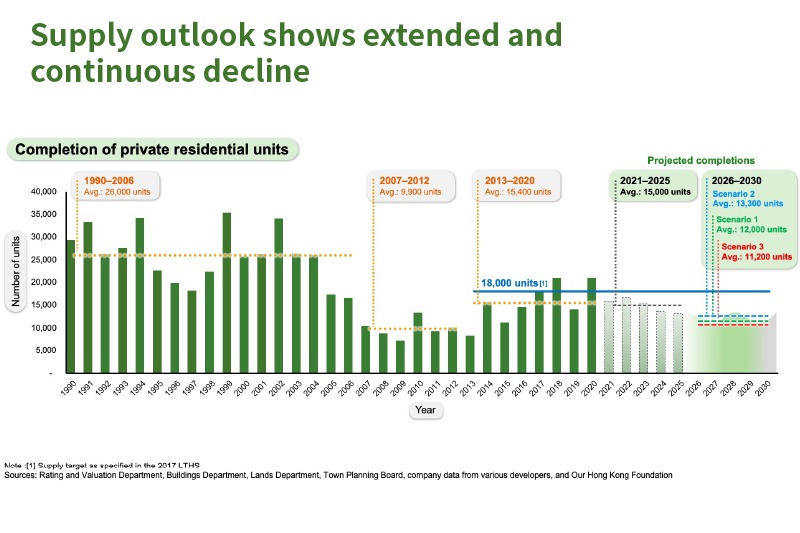
To assess whether the Government could achieve its LTHS ten-year housing supply target, we have provided an exclusive ten-year forecast on public and private housing supply and a quantitative analysis on reaching the LTHS target. The Government has announced in the 2020 Policy Address that it had identified all the land required for 316,000 public housing units in the next ten years. However, based on OHKF forecast, if all land supply initiatives continue to progress at the current speed, only some 277,400 public housing units could be completed in the same period. To achieve the figure stated in the Policy Address, New Development Areas and other major land supply initiatives will need to be completed with an expedited timeline, approximately two years ahead of their current schedules. In addition, the annual supply of flats from rezoning needs to be increased by 5% over the current level. For private housing, we expect only an average of 12,000 units per year to be completed in 2026–2030. This is 20% lower than the annual average of 15,000 units between 2021 and 2025, and fails to reach the annual target of 12,900 units in the LTHS. If the Government wishes to fulfil the LTHS target, New Development Areas and railway projects need to be completed one year ahead of the original schedule, and supply from private development needs to deliver 5% more of units each year.
To solve the land and housing crisis in Hong Kong, the OHKF advises the Government to take a bold step forward and expedite all major land supply initiatives, including development of New Development Areas, rezoning, topside development on railways, urban redevelopment and others, while streamlining the current administrative procedures for land and housing development. Specifically, we advocate that the Government conducts in-depth study on compressing the development procedures of New Development Areas, and speeds up transport infrastructure projects that support New Development Areas, in particular road infrastructure including Route 11, Tuen Mun Western Bypass, and Lantau Road P1, as well as railway infrastructure including the Northern Link, Tuen Mun South Extension, and Tung Chung Line Extension. Moreover, the OHKF urges the Government to ensure the newly set up Development Projects Facilitation Office announced in 2020 Policy Address can perform its functions effectively to streamline the administrative and approval processes in public and private housing development. On public housing supply, OHKF land report in 2020 has pointed out that many public housing projects may be delayed due to different bureaucratic procedures. The OHKF calls on the Government to leverage on the Steering Group on Streamlining Development Control, with its expanded function from the Policy Address, to improve cross-department coordination and streamline cumbersome government procedures to compress the timeline of public housing development.




On 21 April 2021, Our Hong Kong Foundation (OHKF) has released a new research report on Land and Housing policy entitled Decisive Moment — Can Hong Kong Save Itself from the Land and Housing Supply Crisis? The Report points out that Hong Kong is caught in a deadlock of “triple lows”, respectively in spade-ready land supply, housing completions, and quality of living. A Herculean effort is needed from the HKSAR Government to achieve the ten-year Long Term Housing Strategy (LTHS) housing supply target. The OHKF provides an exclusive ten-year forecast on public and private housing supply. We urge the Government to take immediate action by expediating all land supply initiatives and spare no effort in streamlining the approval processes for land and housing development.
Hong Kong has been increasingly plagued by a lack of good-quality land for housing due to the lack of large-scale land development over the past 20 years, and the stock from existing new towns has been gradually exhausting. The Report cites the land available for private residential development as an example, with the supply falling from the peak level of 25,500 units recorded three years ago to 13,020 units this year. The report forecasts that the number of private residential completions in the next five years will average only approximately 15,000 units per year. This is 28% lower than the 20,900 units completed last year. Public housing supply in the next four years is also expected to lag behind the LTHS target by 28%, with an annual average of 21,800 units. The shortage in supply will also cast a negative light on the quality of living, as Hong Kong people will suffer from the consequence of living in smaller and more expensive flats. It is predicted that the average gross floor area of newly completed private housing units will continue to shrink to less than 600 square feet in 2024, almost one-third smaller than in 2012 (which is equivalent to a saleable area smaller than 480 square feet based on an 80% efficiency ratio).
To assess whether the Government could achieve its LTHS ten-year housing supply target, we have provided an exclusive ten-year forecast on public and private housing supply and a quantitative analysis on reaching the LTHS target. The Government has announced in the 2020 Policy Address that it had identified all the land required for 316,000 public housing units in the next ten years. However, based on OHKF forecast, if all land supply initiatives continue to progress at the current speed, only some 277,400 public housing units could be completed in the same period. To achieve the figure stated in the Policy Address, New Development Areas and other major land supply initiatives will need to be completed with an expedited timeline, approximately two years ahead of their current schedules. In addition, the annual supply of flats from rezoning needs to be increased by 5% over the current level. For private housing, we expect only an average of 12,000 units per year to be completed in 2026–2030. This is 20% lower than the annual average of 15,000 units between 2021 and 2025, and fails to reach the annual target of 12,900 units in the LTHS. If the Government wishes to fulfil the LTHS target, New Development Areas and railway projects need to be completed one year ahead of the original schedule, and supply from private development needs to deliver 5% more of units each year.
To solve the land and housing crisis in Hong Kong, the OHKF advises the Government to take a bold step forward and expedite all major land supply initiatives, including development of New Development Areas, rezoning, topside development on railways, urban redevelopment and others, while streamlining the current administrative procedures for land and housing development. Specifically, we advocate that the Government conducts in-depth study on compressing the development procedures of New Development Areas, and speeds up transport infrastructure projects that support New Development Areas, in particular road infrastructure including Route 11, Tuen Mun Western Bypass, and Lantau Road P1, as well as railway infrastructure including the Northern Link, Tuen Mun South Extension, and Tung Chung Line Extension. Moreover, the OHKF urges the Government to ensure the newly set up Development Projects Facilitation Office announced in 2020 Policy Address can perform its functions effectively to streamline the administrative and approval processes in public and private housing development. On public housing supply, OHKF land report in 2020 has pointed out that many public housing projects may be delayed due to different bureaucratic procedures. The OHKF calls on the Government to leverage on the Steering Group on Streamlining Development Control, with its expanded function from the Policy Address, to improve cross-department coordination and streamline cumbersome government procedures to compress the timeline of public housing development.