






Facilitating Greater Bay Area Talent Flow and Development Opportunities for Hong Kong Citizens




Facilitating Greater Bay Area Talent Flow and Development Opportunities for Hong Kong Citizens

Our Hong Kong Foundation released its latest report on talent flow in the Guangdong-Hong Kong-Macao Greater Bay Area (GBA). The report points out that the flow of talents is an important part in the development of the GBA's synergistic development. The research team conducted three surveys to analyze cross-border working and living issues and Hong Kong citizens' perception of cross-border talents. The team found that Hong Kong citizens generally understood the need for talent mobility in the GBA. Moreover, Hong Kong residents living in the GBA rated their own socio-economic status higher after moving to the Mainland, which shows that the GBA can provide alternative path for Hong Kong citizens’ upward mobility.
However, the surveys also discovered numerous challenges. The report proposes the following policy directions to promote the interconnection and interchange of talents in the GBA.
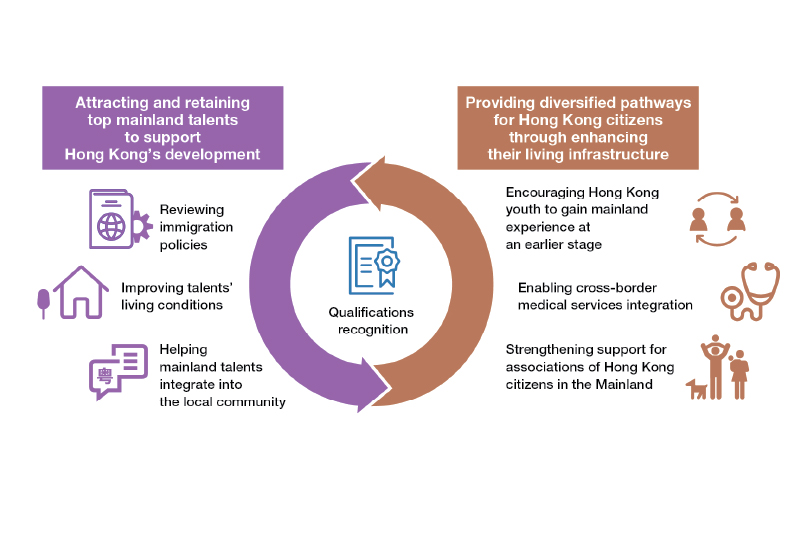
The surveys showed that Hong Kong's ability to attract and retain talents needs to be improved. Therefore, the report recommends that the Hong Kong government should review its immigration policies and improve the living conditions for foreign talents through measures such as talent housing schemes, to attract more talents to come to Hong Kong for employment. The Government may also consider organising free cultural exchange activities for new arrivals to help them integrate into the local community.
The surveys also revealed that the Hong Kong citizens in the GBA need support in their daily lives. Therefore, the report calls on the Hong Kong government to further promote cross-border medical integration and strengthen support for associations of Hong Kong citizens in the Mainland, which combines its resource advantages and the extensive experiences of these associations to provide the appropriate support for Hong Kong citizens in the Mainland. The report also points out that in view of the lack of an academic and professional qualifications framework across all sectors in the GBA, the Hong Kong government should continue to work with its counterparts in the Mainland to establish a wider qualifications recognition ecosystem.




Our Hong Kong Foundation released its latest report on talent flow in the Guangdong-Hong Kong-Macao Greater Bay Area (GBA). The report points out that the flow of talents is an important part in the development of the GBA's synergistic development. The research team conducted three surveys to analyze cross-border working and living issues and Hong Kong citizens' perception of cross-border talents. The team found that Hong Kong citizens generally understood the need for talent mobility in the GBA. Moreover, Hong Kong residents living in the GBA rated their own socio-economic status higher after moving to the Mainland, which shows that the GBA can provide alternative path for Hong Kong citizens’ upward mobility.
However, the surveys also discovered numerous challenges. The report proposes the following policy directions to promote the interconnection and interchange of talents in the GBA.
The surveys showed that Hong Kong's ability to attract and retain talents needs to be improved. Therefore, the report recommends that the Hong Kong government should review its immigration policies and improve the living conditions for foreign talents through measures such as talent housing schemes, to attract more talents to come to Hong Kong for employment. The Government may also consider organising free cultural exchange activities for new arrivals to help them integrate into the local community.
The surveys also revealed that the Hong Kong citizens in the GBA need support in their daily lives. Therefore, the report calls on the Hong Kong government to further promote cross-border medical integration and strengthen support for associations of Hong Kong citizens in the Mainland, which combines its resource advantages and the extensive experiences of these associations to provide the appropriate support for Hong Kong citizens in the Mainland. The report also points out that in view of the lack of an academic and professional qualifications framework across all sectors in the GBA, the Hong Kong government should continue to work with its counterparts in the Mainland to establish a wider qualifications recognition ecosystem.