








Webinar with Professor Richard Wong: Livelihoods, Public Sentiment, and Populism




Webinar with Professor Richard Wong: Livelihoods, Public Sentiment, and Populism

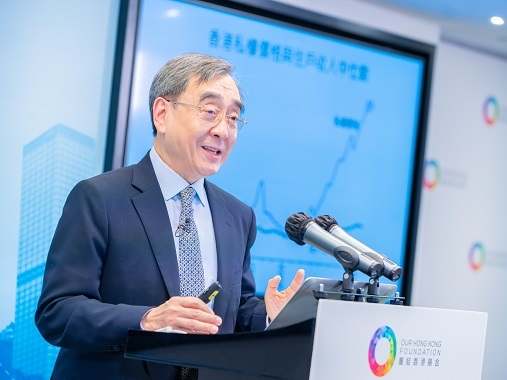

(11 September 2020, Hong Kong) It has been a difficult time for Hong Kong's economy and people's livelihoods over recent years, as social mobility weakens, wealth disparity worsens and social polarisation deepens. At the 8th ‘INSIGHT FORUM’ webinar organised by Our Hong Kong Foundation (OHKF), Professor Richard Wong, Philip Wong Kennedy Wong Professor at The University of Hong Kong, expressed that an ‘Affordable Homeownership for All Hong Kong People’ is the sole answer to Hong Kong’s severe problems regarding livelihood and populism. Granting basically every Hong Kong citizen with the option to purchase public housing units at affordable prices would be an urgently needed step forward in furthering Hong Kong’s overall economic development and achieving shared prosperity.
Young People Are Losing Confidence Because of Economic Downturn and Declining Livelihood
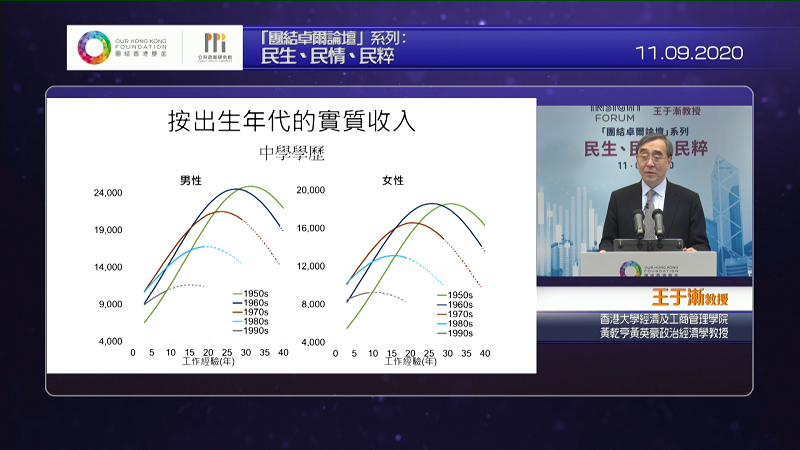
The rise of Hong Kong's financial, real estate and tourism industries since Hong Kong’s return to China, coupled with technological advancements and the globalisation movement, has been seen as skewing to the benefit of the wealthier class. However, income growth for the grass-roots community is unable to keep up with the pace of economic development and rapidly rising house prices. Weakening social mobility and worsening income inequality between the rich and poor have greatly aggravated polarisation within society.
Professor Wong saw Hongkongers as pragmatic and rational, setting their focus more on the economy and livelihoods than politics. The inception of social movement last year against the extradition bill, however, has seen a swift rise of localism, political radicalism, and even separatism. The root cause of these populists and radical tendencies in Hong Kong society, especially among the young generations, lies in the deep-seated social and economic conflicts.
Broken Housing Ladder Gives Rise to Populism
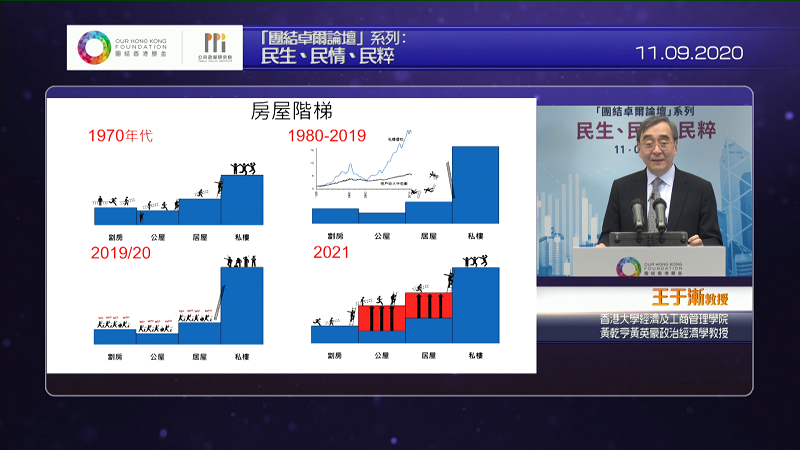
With the increase in life expectancy of Hong Kong population, the turnover rate of public housing units has significantly dwindled. 2016 data showed that as many as 44.2% of households of elderly people aged 65 or above live in public units. In addition, housing supply is far outstripped by demand, while private housing are priced beyond the affordability of ordinary citizens. Those awaiting public units have little choice but to tolerate high rents or are even forced to live in sub-divided units.
As stated by Professor Wong, public opinion surveys in recent years have revealed that housing always tops the priority issue of Hong Kong people. Admittedly, housing is also seen as the weakest link in the Hong Kong SAR Government. Land development has almost grinded to a halt, resulting in a serious land shortage and insufficient housing supply. With grass-roots families checked from moving upward socially, together with a broken housing ladder and aggravated dissatisfaction with the government, localism and populism were gaining momentum.
‘Affordable Homeownership for All Hong Kong People’: Gaining Public Support by Ensuring Housing Accessibility
To quickly alleviate the wealth disparity and social polarisation in Hong Kong, Professor Wong, making reference to Singapore’s HDB housing model, pointed to Hong Kong’s own ‘affordable homeownership for all’ as the answer. He called for a promise by the Government that basically every Hong Kong citizen is entitled to becoming an owner of affordable public housing units. The first step is to fully launch the optimised Tenant Purchase Scheme 2.0 (TPS) and sell public housing units to dwelling tenants at low prices. The Government should also reduce or waive altogether the premium for subsidised flats under the ‘Home Ownership Scheme’ and ‘Tensing Purchase Scheme’, thereby letting owners take full ownership of the properties with associated advantages. The ‘Affordable Homeownership for All Hong Kong People’ initiative is expected to benefit about 3.3 million residents in public housing and subsidised sale flats, thus increasing the overall home ownership rate in Hong Kong from below 50% to 70% or above.
Adequate land supply is a pre-requisite for home building. Professor Wong recommended that the Government should expedite the implementation of recent or planned land development projects, while concurrently developing more land and building up a land reserve for meeting longer-term demand. Options include building more new towns in the New Territories, developing the Tsing Shan Firing Range, and conducting further research on reclaiming land south of Cheung Chau for relocating the Kwai Tsing Container Terminals so as to release valuable land for residential development. ‘Once citizens become property owners, their wealth will swell by means of asset appreciation,’ said Professor Wong, and ‘this will promote overall economic development, and truly help achieve shared prosperity in society.’
‘Livelihoods, Public Sentiment, and Populism’:
Full live webinar: https://youtu.be/NQ6YvFL3egY?t=334


(11 September 2020, Hong Kong) It has been a difficult time for Hong Kong's economy and people's livelihoods over recent years, as social mobility weakens, wealth disparity worsens and social polarisation deepens. At the 8th ‘INSIGHT FORUM’ webinar organised by Our Hong Kong Foundation (OHKF), Professor Richard Wong, Philip Wong Kennedy Wong Professor at The University of Hong Kong, expressed that an ‘Affordable Homeownership for All Hong Kong People’ is the sole answer to Hong Kong’s severe problems regarding livelihood and populism. Granting basically every Hong Kong citizen with the option to purchase public housing units at affordable prices would be an urgently needed step forward in furthering Hong Kong’s overall economic development and achieving shared prosperity.
Young People Are Losing Confidence Because of Economic Downturn and Declining Livelihood
The rise of Hong Kong's financial, real estate and tourism industries since Hong Kong’s return to China, coupled with technological advancements and the globalisation movement, has been seen as skewing to the benefit of the wealthier class. However, income growth for the grass-roots community is unable to keep up with the pace of economic development and rapidly rising house prices. Weakening social mobility and worsening income inequality between the rich and poor have greatly aggravated polarisation within society.
Professor Wong saw Hongkongers as pragmatic and rational, setting their focus more on the economy and livelihoods than politics. The inception of social movement last year against the extradition bill, however, has seen a swift rise of localism, political radicalism, and even separatism. The root cause of these populists and radical tendencies in Hong Kong society, especially among the young generations, lies in the deep-seated social and economic conflicts.
Broken Housing Ladder Gives Rise to Populism
With the increase in life expectancy of Hong Kong population, the turnover rate of public housing units has significantly dwindled. 2016 data showed that as many as 44.2% of households of elderly people aged 65 or above live in public units. In addition, housing supply is far outstripped by demand, while private housing are priced beyond the affordability of ordinary citizens. Those awaiting public units have little choice but to tolerate high rents or are even forced to live in sub-divided units.
As stated by Professor Wong, public opinion surveys in recent years have revealed that housing always tops the priority issue of Hong Kong people. Admittedly, housing is also seen as the weakest link in the Hong Kong SAR Government. Land development has almost grinded to a halt, resulting in a serious land shortage and insufficient housing supply. With grass-roots families checked from moving upward socially, together with a broken housing ladder and aggravated dissatisfaction with the government, localism and populism were gaining momentum.
‘Affordable Homeownership for All Hong Kong People’: Gaining Public Support by Ensuring Housing Accessibility
To quickly alleviate the wealth disparity and social polarisation in Hong Kong, Professor Wong, making reference to Singapore’s HDB housing model, pointed to Hong Kong’s own ‘affordable homeownership for all’ as the answer. He called for a promise by the Government that basically every Hong Kong citizen is entitled to becoming an owner of affordable public housing units. The first step is to fully launch the optimised Tenant Purchase Scheme 2.0 (TPS) and sell public housing units to dwelling tenants at low prices. The Government should also reduce or waive altogether the premium for subsidised flats under the ‘Home Ownership Scheme’ and ‘Tensing Purchase Scheme’, thereby letting owners take full ownership of the properties with associated advantages. The ‘Affordable Homeownership for All Hong Kong People’ initiative is expected to benefit about 3.3 million residents in public housing and subsidised sale flats, thus increasing the overall home ownership rate in Hong Kong from below 50% to 70% or above.
Adequate land supply is a pre-requisite for home building. Professor Wong recommended that the Government should expedite the implementation of recent or planned land development projects, while concurrently developing more land and building up a land reserve for meeting longer-term demand. Options include building more new towns in the New Territories, developing the Tsing Shan Firing Range, and conducting further research on reclaiming land south of Cheung Chau for relocating the Kwai Tsing Container Terminals so as to release valuable land for residential development. ‘Once citizens become property owners, their wealth will swell by means of asset appreciation,’ said Professor Wong, and ‘this will promote overall economic development, and truly help achieve shared prosperity in society.’
‘Livelihoods, Public Sentiment, and Populism’:
Full live webinar: https://youtu.be/NQ6YvFL3egY?t=334