








Infrastructure + Regulation Support - The Low-Altitude Economy Takes Flight Steadily




Infrastructure + Regulation Support - The Low-Altitude Economy Takes Flight Steadily

The source text is in Chinese. This English version is for reference only. In case of any discrepancy between this English version and the Chinese version, the Chinese version shall prevail.
Earlier, the highly anticipated International Hot Air Balloon Festival in Central was compelled to cancel multiple flight demonstration sessions. The primary reasons were the absence of Government approval for passenger operations and adverse weather conditions, resulting in disappointment among many citizens.

This incident underscores an important lesson: any activity that involves "leaving the ground"—whether as simple as a hot air balloon or as complex as future drone networks—must ensure that it "flies steadily". When extending this perspective from individual activities to the broader strategic emerging industry of the low-altitude economy, the importance of "flying steadily" becomes even more apparent.
The low-altitude economy generally refers to economic activities conducted within airspace below 1,000 meters above ground level, covering logistics, rescue, surveying, passenger transport, and tourism. According to Morgan Stanley, by 2050 the global market size of urban air mobility and logistics will reach USD 9 trillion.
Four Core Functions to Equip the Airspace with "Sight and Hearing"
Facing such a massive market, the Policy Address has listed the development of the low-altitude economy as an important initiative to inject new momentum into Hong Kong's economy. However, transforming this vision into reality necessitates a systematic, phased approach. This series of articles will be divided into three parts to explore in depth the future direction of Hong Kong's low-altitude economic development, beginning with its fundamental cornerstone: infrastructure and regulation.
Although Hong Kong possesses a world-class communications network, the existing facilities are insufficient to support a large-scale low-altitude economic system. Therefore, establishing a comprehensive low-altitude infrastructure network with four core functions—communications, monitoring, navigation, and meteorology—is a necessary direction. For example, Hong Kong can upgrade existing 4G/5G base stations by adding antennas or related equipment to extend ground signals "upward" into the air to cover key flight corridors. In the long term, it should progressively upgrade to 5G-A and even 6G networks to reduce latency and increase connection density. For areas with weak signals, such as country parks, low-orbit satellite communication systems could serve as supplementary solutions.
Beyond invisible signal networks, physical take-off and landing facilities and flight corridors form the backbone of the low-altitude economy. In new development areas such as Hung Shui Kiu and San Tin, low-altitude take-off points and charging stations should be included in early-stage city planning to prevent costly future reconfigurations. In existing new towns, the first batch of public take-off and landing sites can be established using public spaces, such as parks.
More importantly, forward-looking air route planning must be carried out. These corridors should align with ground planning, such as controlling the height and population density of buildings beneath flight paths to reduce potential risks. At the same time, the authorities should actively coordinate with Shenzhen to achieve cross-boundary flight route planning synergy.
Some may raise concerns about the potentially large capital investment required for such construction. However, the Government does not need to bear all the costs alone. It can adopt public-private partnerships or "operation-to-fund-infrastructure" models to attract private capital, relieve fiscal pressure, and accelerate the formation of the network.
Strengthening Airspace Management to Build an "Intelligent Brain"
In addition to the hardware infrastructure mentioned above, software infrastructure is equally important. Currently, Hong Kong's airspace below 1,000 meters lacks an airspace management system similar to that used in civil aviation. The urgent task of establishing such a system is vital in order to evolve from scattered flight activities into a safe, orderly, and economically scaled industry. This system should have three main functions: risk assessment, flight approval, and airspace management.
Risk assessment should integrate parameters such as wind speed, visibility, crowd density, satellite signal strength, and collision potential to generate a comprehensive “safety score” for each flight. This score would provide an objective basis for flight approval processes, prompting mitigation measures when risks are elevated and informing insurance-related decisions.
Flight approval procedures should be predominantly AI-driven, enabling automatic application assessments, route adjustments, or rejections where necessary, balancing regulatory oversight with operational efficiency.
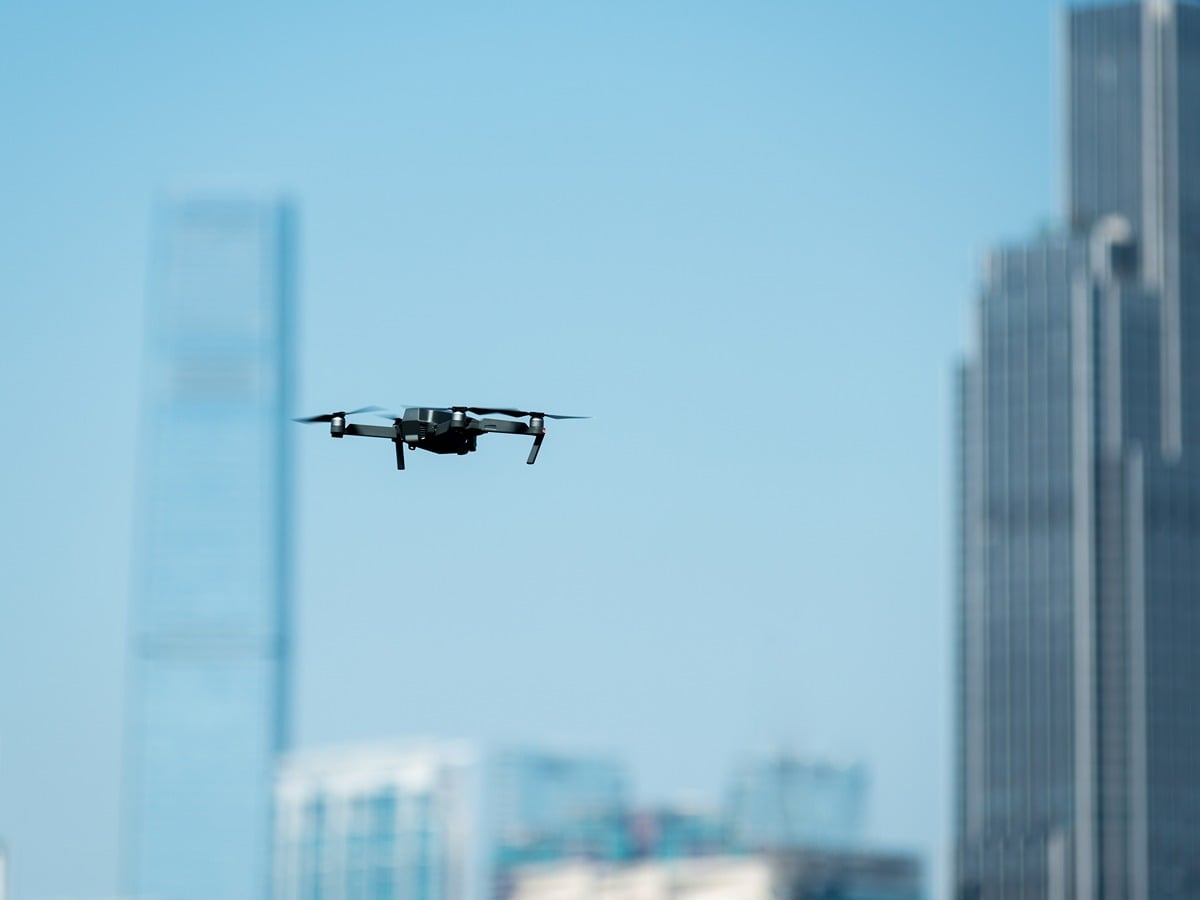
As for airspace management, it should be mandatory that all drones adopt a "one drone, one code" system supporting Remote ID (remote identification) functionality, serving as a digital identity card for each drone. This function continuously broadcasts the drone's location, altitude, speed, and abnormal status, ensuring safe interaction between various flight operations. This would give regulators real-time capability to monitor the airspace, detect and track illegal "black flights", and provide "black box"-like data records for accident investigation to clarify liability.
Considering Hong Kong's circumstances, a pragmatic path forward is to adopt a phased approach to infrastructure development. We suggest that after completing the two phases of the "regulatory sandbox", the Government should first establish a "Low-Altitude Economy Pilot Demonstration Zone" in the Northern Metropolis, advancing low-altitude infrastructure construction in stages of "points, lines, and areas". Within the demonstration zone, the Government can combine market demand and prioritise the deployment of communications, monitoring, navigation, meteorology, and take-off and landing infrastructure, while building an initial version of the low-altitude air traffic management system.
Once the demonstration zone has taken shape, the "points" can be connected into "lines" by opening public flight corridors within and around the Northern Metropolis, and then connecting these with Shenzhen’s flight routes to establish cross-border coordination standards and circulation mechanisms. When data and systems mature, the network can expand into "areas", forming a citywide low-altitude infrastructure network across Hong Kong.
The construction of hardware and software systems ultimately requires legal and regulatory support to be implemented. Currently, Hong Kong's Small Unmanned Aircraft Order mainly regulates drones under 150 kilograms and strictly requires "visual line-of-sight operations". However, the major commercial potential of the low-altitude economy lies precisely in allowing remote pilots to perform "beyond visual line of sight" operations and the use of large drones for intercity logistics.
Learning from the European Union - Removing Barriers for the Low-Altitude Economy
Hong Kong should draw on the experience of the European Union and other regions to establish a risk-based regulatory framework. By analysing data collected from the "regulatory sandbox", the Government can progressively amend legislation to specify clear rules and technical standards for beyond-visual-line-of-sight operations.
In the long term, new dedicated legislation should be formulated for emerging aircraft types such as heavy drones over 150 kilograms and passenger-carrying vertical take-off and landing vehicles, paving the way for their large-scale commercial adoption.
As the challenges behind the hot air balloon festival demonstrate, without safe, efficient, and reliable foundational support, no low-altitude activity can develop on a scalable basis. A comprehensive infrastructure network, an intelligent airspace management system, and timely, adaptive laws and regulations are the essential starting points. Like the foundation of a building, they may not be visible but determine the height and stability of the structure above. With sound infrastructure and regulations ensuring that Hong Kong's low-altitude economy can "fly steadily", the next article in this series will explore how it can "fly far" — by fostering innovation and talent to provide continuous momentum for Hong Kong's low-altitude economic development.
(Series Analysis Part 1 of 3)


The source text is in Chinese. This English version is for reference only. In case of any discrepancy between this English version and the Chinese version, the Chinese version shall prevail.
Earlier, the highly anticipated International Hot Air Balloon Festival in Central was compelled to cancel multiple flight demonstration sessions. The primary reasons were the absence of Government approval for passenger operations and adverse weather conditions, resulting in disappointment among many citizens.
This incident underscores an important lesson: any activity that involves "leaving the ground"—whether as simple as a hot air balloon or as complex as future drone networks—must ensure that it "flies steadily". When extending this perspective from individual activities to the broader strategic emerging industry of the low-altitude economy, the importance of "flying steadily" becomes even more apparent.
The low-altitude economy generally refers to economic activities conducted within airspace below 1,000 meters above ground level, covering logistics, rescue, surveying, passenger transport, and tourism. According to Morgan Stanley, by 2050 the global market size of urban air mobility and logistics will reach USD 9 trillion.
Four Core Functions to Equip the Airspace with "Sight and Hearing"
Facing such a massive market, the Policy Address has listed the development of the low-altitude economy as an important initiative to inject new momentum into Hong Kong's economy. However, transforming this vision into reality necessitates a systematic, phased approach. This series of articles will be divided into three parts to explore in depth the future direction of Hong Kong's low-altitude economic development, beginning with its fundamental cornerstone: infrastructure and regulation.
Although Hong Kong possesses a world-class communications network, the existing facilities are insufficient to support a large-scale low-altitude economic system. Therefore, establishing a comprehensive low-altitude infrastructure network with four core functions—communications, monitoring, navigation, and meteorology—is a necessary direction. For example, Hong Kong can upgrade existing 4G/5G base stations by adding antennas or related equipment to extend ground signals "upward" into the air to cover key flight corridors. In the long term, it should progressively upgrade to 5G-A and even 6G networks to reduce latency and increase connection density. For areas with weak signals, such as country parks, low-orbit satellite communication systems could serve as supplementary solutions.
Beyond invisible signal networks, physical take-off and landing facilities and flight corridors form the backbone of the low-altitude economy. In new development areas such as Hung Shui Kiu and San Tin, low-altitude take-off points and charging stations should be included in early-stage city planning to prevent costly future reconfigurations. In existing new towns, the first batch of public take-off and landing sites can be established using public spaces, such as parks.
More importantly, forward-looking air route planning must be carried out. These corridors should align with ground planning, such as controlling the height and population density of buildings beneath flight paths to reduce potential risks. At the same time, the authorities should actively coordinate with Shenzhen to achieve cross-boundary flight route planning synergy.
Some may raise concerns about the potentially large capital investment required for such construction. However, the Government does not need to bear all the costs alone. It can adopt public-private partnerships or "operation-to-fund-infrastructure" models to attract private capital, relieve fiscal pressure, and accelerate the formation of the network.
Strengthening Airspace Management to Build an "Intelligent Brain"
In addition to the hardware infrastructure mentioned above, software infrastructure is equally important. Currently, Hong Kong's airspace below 1,000 meters lacks an airspace management system similar to that used in civil aviation. The urgent task of establishing such a system is vital in order to evolve from scattered flight activities into a safe, orderly, and economically scaled industry. This system should have three main functions: risk assessment, flight approval, and airspace management.
Risk assessment should integrate parameters such as wind speed, visibility, crowd density, satellite signal strength, and collision potential to generate a comprehensive “safety score” for each flight. This score would provide an objective basis for flight approval processes, prompting mitigation measures when risks are elevated and informing insurance-related decisions.
Flight approval procedures should be predominantly AI-driven, enabling automatic application assessments, route adjustments, or rejections where necessary, balancing regulatory oversight with operational efficiency.
As for airspace management, it should be mandatory that all drones adopt a "one drone, one code" system supporting Remote ID (remote identification) functionality, serving as a digital identity card for each drone. This function continuously broadcasts the drone's location, altitude, speed, and abnormal status, ensuring safe interaction between various flight operations. This would give regulators real-time capability to monitor the airspace, detect and track illegal "black flights", and provide "black box"-like data records for accident investigation to clarify liability.
Considering Hong Kong's circumstances, a pragmatic path forward is to adopt a phased approach to infrastructure development. We suggest that after completing the two phases of the "regulatory sandbox", the Government should first establish a "Low-Altitude Economy Pilot Demonstration Zone" in the Northern Metropolis, advancing low-altitude infrastructure construction in stages of "points, lines, and areas". Within the demonstration zone, the Government can combine market demand and prioritise the deployment of communications, monitoring, navigation, meteorology, and take-off and landing infrastructure, while building an initial version of the low-altitude air traffic management system.
Once the demonstration zone has taken shape, the "points" can be connected into "lines" by opening public flight corridors within and around the Northern Metropolis, and then connecting these with Shenzhen’s flight routes to establish cross-border coordination standards and circulation mechanisms. When data and systems mature, the network can expand into "areas", forming a citywide low-altitude infrastructure network across Hong Kong.
The construction of hardware and software systems ultimately requires legal and regulatory support to be implemented. Currently, Hong Kong's Small Unmanned Aircraft Order mainly regulates drones under 150 kilograms and strictly requires "visual line-of-sight operations". However, the major commercial potential of the low-altitude economy lies precisely in allowing remote pilots to perform "beyond visual line of sight" operations and the use of large drones for intercity logistics.
Learning from the European Union - Removing Barriers for the Low-Altitude Economy
Hong Kong should draw on the experience of the European Union and other regions to establish a risk-based regulatory framework. By analysing data collected from the "regulatory sandbox", the Government can progressively amend legislation to specify clear rules and technical standards for beyond-visual-line-of-sight operations.
In the long term, new dedicated legislation should be formulated for emerging aircraft types such as heavy drones over 150 kilograms and passenger-carrying vertical take-off and landing vehicles, paving the way for their large-scale commercial adoption.
As the challenges behind the hot air balloon festival demonstrate, without safe, efficient, and reliable foundational support, no low-altitude activity can develop on a scalable basis. A comprehensive infrastructure network, an intelligent airspace management system, and timely, adaptive laws and regulations are the essential starting points. Like the foundation of a building, they may not be visible but determine the height and stability of the structure above. With sound infrastructure and regulations ensuring that Hong Kong's low-altitude economy can "fly steadily", the next article in this series will explore how it can "fly far" — by fostering innovation and talent to provide continuous momentum for Hong Kong's low-altitude economic development.
(Series Analysis Part 1 of 3)