










Hong Kong Housing Landscape Navigator 2026




Hong Kong Housing Landscape Navigator 2026

Hong Kong’s housing landscape has reached a decisive turning point. After a prolonged correction, the private housing market’s synchronised recovery in prices and transaction volumes signals a firmly established rebound. Concurrently, the public housing sector is entering a strategic harvest phase, creating a rare opportunity to shift focus from simply producing new units to systematically redeveloping a rapidly ageing stock.
Our Hong Kong Foundation (OHKF) released its Hong Kong Housing Landscape Navigator 2026, presenting a comprehensive and up-to-date analysis of the latest housing supply trends and overarching housing policy directions.
Private Housing Market Review
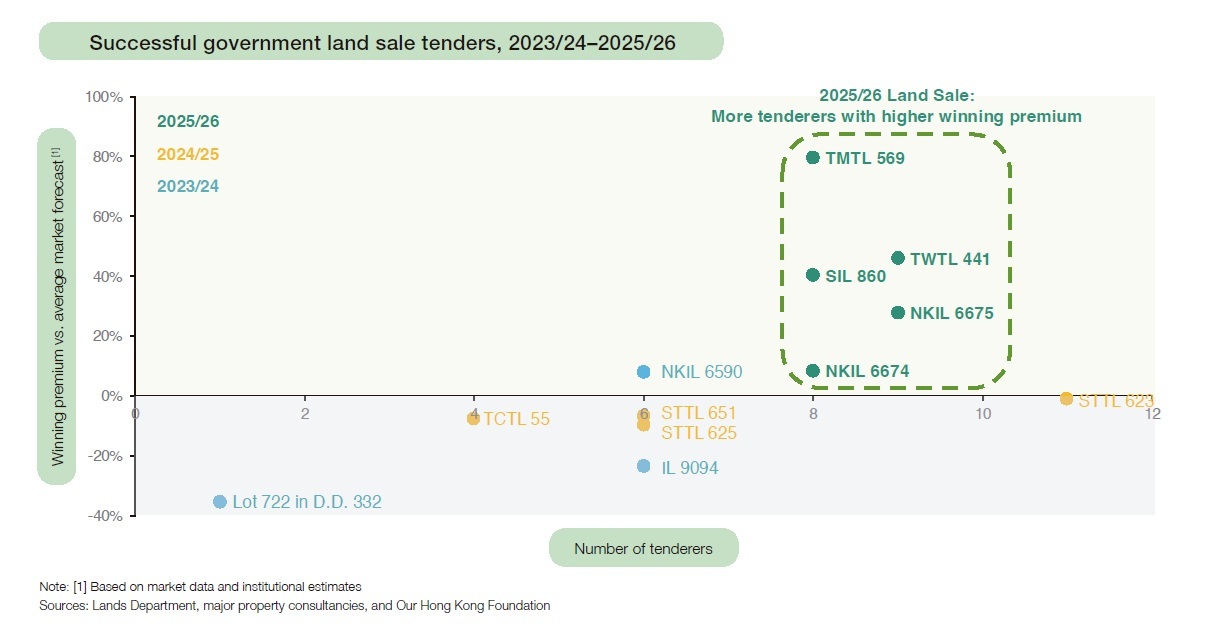
The Hong Kong private housing market entered a “double-growth” recovery in 2025, with momentum concentrated in the entry-level segment. This resurgence was catalysed by the stamp duty threshold adjustments and the withdrawal of “spicy measures” which revitalised both investor interest and entry-level demand. Net absorption returned to positive territory for the first time since 2021. Consequently, unsold stock dropped 18% from its peak, and the eased pressure shifted developers' strategies from aggressive price concessions towards profit-optimised pricing. In the land market, intensified bidding activity for government sites, characterised by narrowing bid spreads and an average of eight to nine tenders per site, indicates a unified conviction that land values have established a floor.
Private Housing Market Outlook
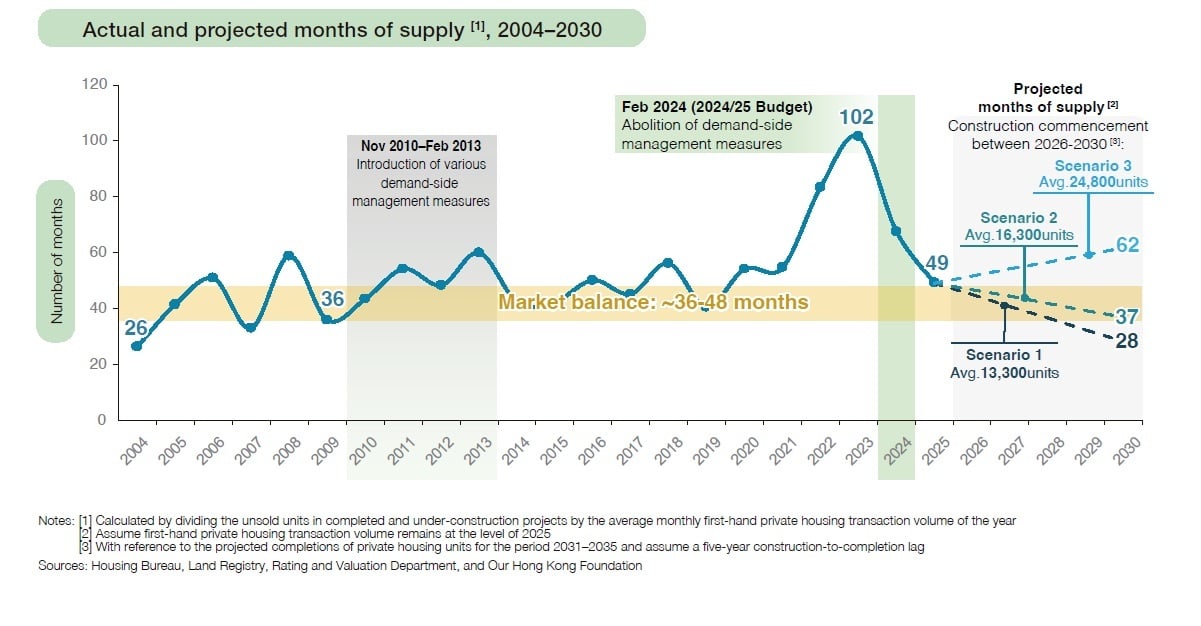
Looking ahead, average annual completions are projected at 17,100 units for the 2026–2030 period. However, the near-term supply pipeline is expected to hit a cyclical trough. On the demand side, Hong Kong’s population has staged a robust “V-shaped” rebound, creating a resilient new demand pillar and actively driving the rental market to record highs. Integrating demand and supply factors, the “months of supply” metric reflects a rapidly tightening market, halving from 102 months in 2023 to 49 months by 2025. The projection further shows that the ratio could range between 28 and 62 months by 2030. Therefore, OHKF recommends a proactive framework that monitors the “months of supply” ratio alongside price to assess structural market health. This enables the authorities to actively regulate the sector by calibrating land disposal through adaptive mechanisms.
Public Housing Policy Spotlight
The report highlights the steady progress made by the authorities in recent years in accelerating housing construction, shortening waiting times, and enhancing living quality. In terms of advancing public housing redevelopment, the number of units in currently planned or ongoing projects has expanded significantly to approximately 41,000, far exceeding the cumulative completion of 17,000 units over the past decade. However, the ageing of public rental housing (PRH) estates presents a substantial challenge. Over the next ten years, more than 230,000 units under the Housing Authority are expected to reach the 50-year mark, while average per-unit maintenance and improvement expenditures continue to rise. Proactive planning is therefore essential. With a fundamentally improved supply outlook, Hong Kong should seize the opportunity to systematically drive the redevelopment of ageing estates.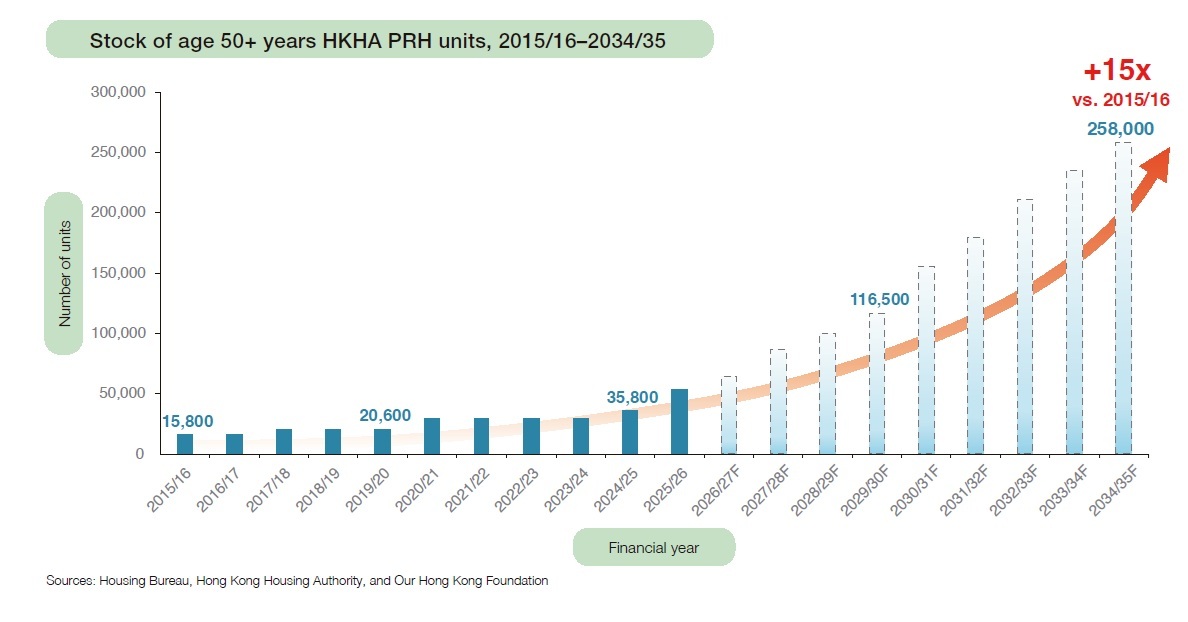




Hong Kong’s housing landscape has reached a decisive turning point. After a prolonged correction, the private housing market’s synchronised recovery in prices and transaction volumes signals a firmly established rebound. Concurrently, the public housing sector is entering a strategic harvest phase, creating a rare opportunity to shift focus from simply producing new units to systematically redeveloping a rapidly ageing stock.
Our Hong Kong Foundation (OHKF) released its Hong Kong Housing Landscape Navigator 2026, presenting a comprehensive and up-to-date analysis of the latest housing supply trends and overarching housing policy directions.
Private Housing Market Review
The Hong Kong private housing market entered a “double-growth” recovery in 2025, with momentum concentrated in the entry-level segment. This resurgence was catalysed by the stamp duty threshold adjustments and the withdrawal of “spicy measures” which revitalised both investor interest and entry-level demand. Net absorption returned to positive territory for the first time since 2021. Consequently, unsold stock dropped 18% from its peak, and the eased pressure shifted developers' strategies from aggressive price concessions towards profit-optimised pricing. In the land market, intensified bidding activity for government sites, characterised by narrowing bid spreads and an average of eight to nine tenders per site, indicates a unified conviction that land values have established a floor.
Private Housing Market Outlook
Looking ahead, average annual completions are projected at 17,100 units for the 2026–2030 period. However, the near-term supply pipeline is expected to hit a cyclical trough. On the demand side, Hong Kong’s population has staged a robust “V-shaped” rebound, creating a resilient new demand pillar and actively driving the rental market to record highs. Integrating demand and supply factors, the “months of supply” metric reflects a rapidly tightening market, halving from 102 months in 2023 to 49 months by 2025. The projection further shows that the ratio could range between 28 and 62 months by 2030. Therefore, OHKF recommends a proactive framework that monitors the “months of supply” ratio alongside price to assess structural market health. This enables the authorities to actively regulate the sector by calibrating land disposal through adaptive mechanisms.
Public Housing Policy Spotlight
The report highlights the steady progress made by the authorities in recent years in accelerating housing construction, shortening waiting times, and enhancing living quality. In terms of advancing public housing redevelopment, the number of units in currently planned or ongoing projects has expanded significantly to approximately 41,000, far exceeding the cumulative completion of 17,000 units over the past decade. However, the ageing of public rental housing (PRH) estates presents a substantial challenge. Over the next ten years, more than 230,000 units under the Housing Authority are expected to reach the 50-year mark, while average per-unit maintenance and improvement expenditures continue to rise. Proactive planning is therefore essential. With a fundamentally improved supply outlook, Hong Kong should seize the opportunity to systematically drive the redevelopment of ageing estates.