







Setting Sail from Hong Kong: A New Era for Enterprises Going Global




Setting Sail from Hong Kong: A New Era for Enterprises Going Global

As the national economy enters a new normal, Mainland enterprises are confronting a reality of “go global or lose out”. In support of the national strategy outlined in the 14th and 15th Five-Year Plans to expand high-level opening-up, the 2025 Policy Address announced the establishment of the Task Force on Supporting Mainland Enterprises in Going Global (GoGlobal Task Force). Between 2018 and 2025, Mainland-affiliated companies in Hong Kong grew from 1,591 to 3,090—an increase of 94%—demonstrating Hong Kong’s growing appeal as the preferred platform for enterprises going global.
In light of this, Our Hong Kong Foundation (OHKF) published a research report titled Setting Sail from Hong Kong: A New Era for Enterprises Going Global. By adopting an entrepreneur’s perspective, this report provides a comprehensive analysis of how Hong Kong can improve its one-stop services for enterprises going global.
Enterprises’ needs and Hong Kong’s strengths
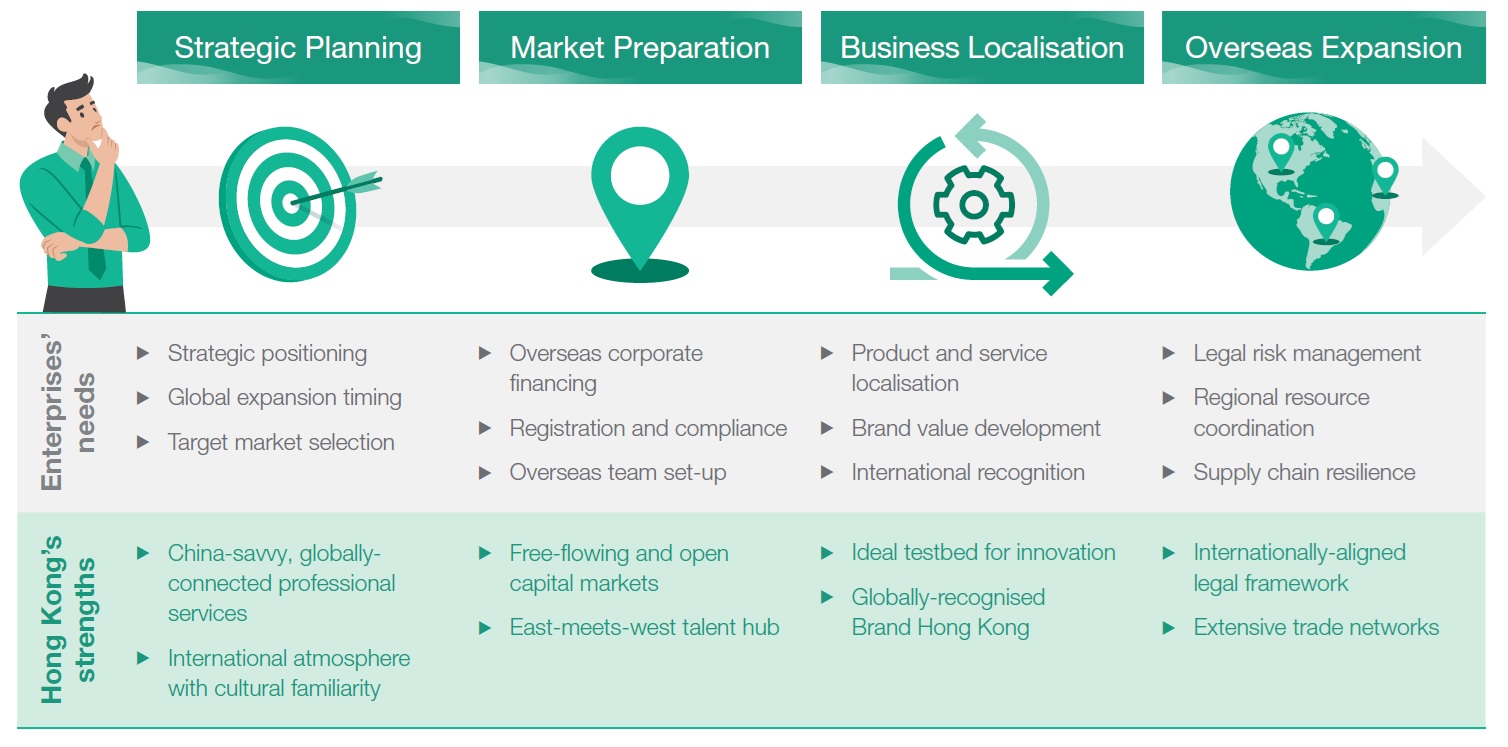
To evaluate Hong Kong’s services, this report begins by mapping out enterprises’ go-global journey into four stages: strategic planning, market preparation, business localisation, and overseas expansion. At each stage, enterprises encounter diverse needs such as strategic positioning, overseas corporate financing, product localisation, and legal risk management. Hong Kong’s traditional strengths, including China-savvy, globally-connected professional services, free-flowing and open capital markets, overseas-oriented application scenarios, and internationally-aligned legal framework, are well-placed to meet these needs systematically, providing enterprises with end-to-end support.
Pain points in Hong Kong’s services
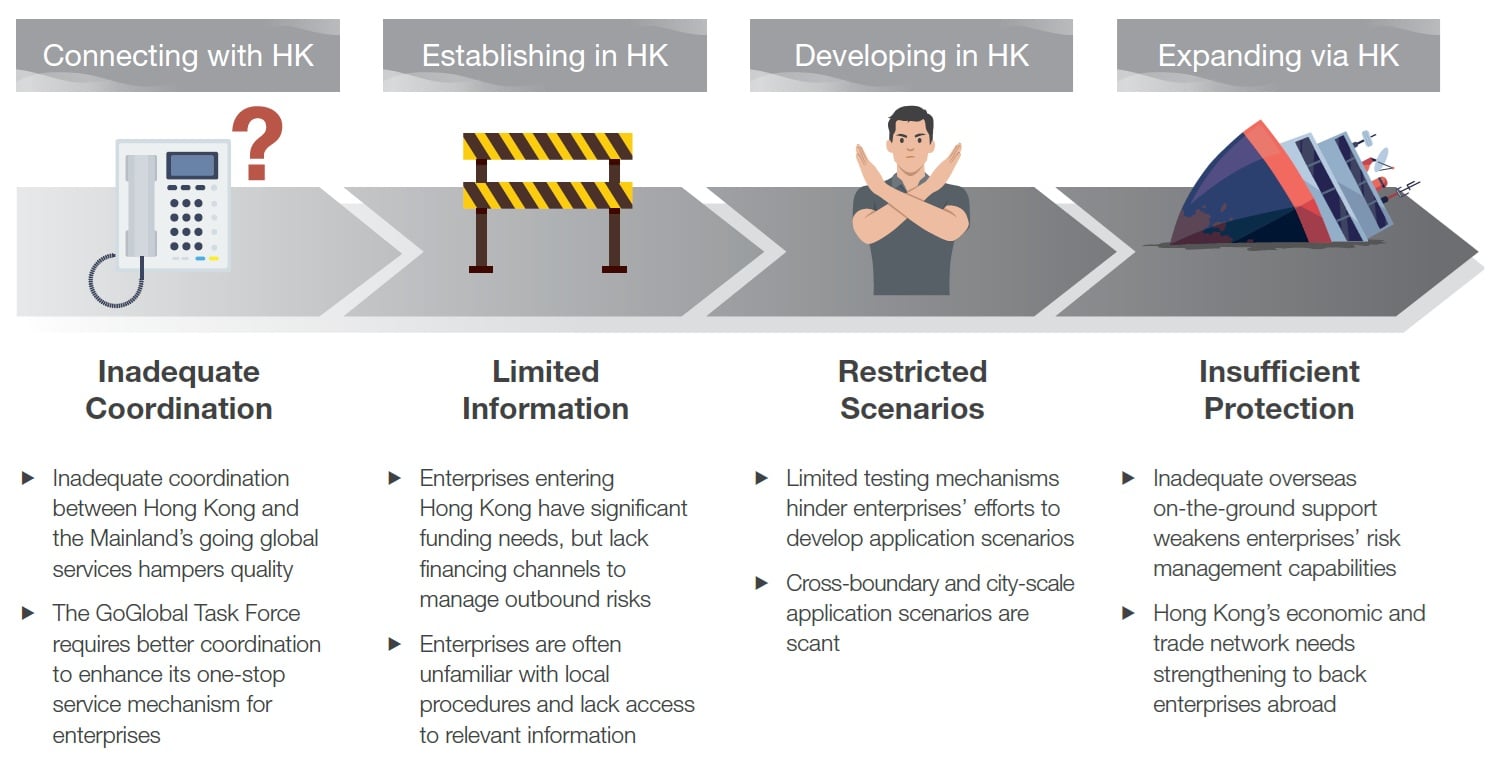
Despite Hong Kong’s clear advantages as the preferred first stop for enterprises going global, notable pain points remain throughout the four key stages of the journey: Connecting with Hong Kong, Establishing in Hong Kong, Developing in Hong Kong, and Expanding via Hong Kong. These pain points include inadequate coordination between Hong Kong and the Mainland’s services, limited access to practical information about setting up in Hong Kong, insufficient application scenarios for products and services, and inadequate on-the-ground support and regulatory protection to back enterprises abroad. Such pain points restrict the full realisation of Hong Kong’s potential in providing go-global services.
Four-stage recommendations to develop the preferred first stop for enterprises going global
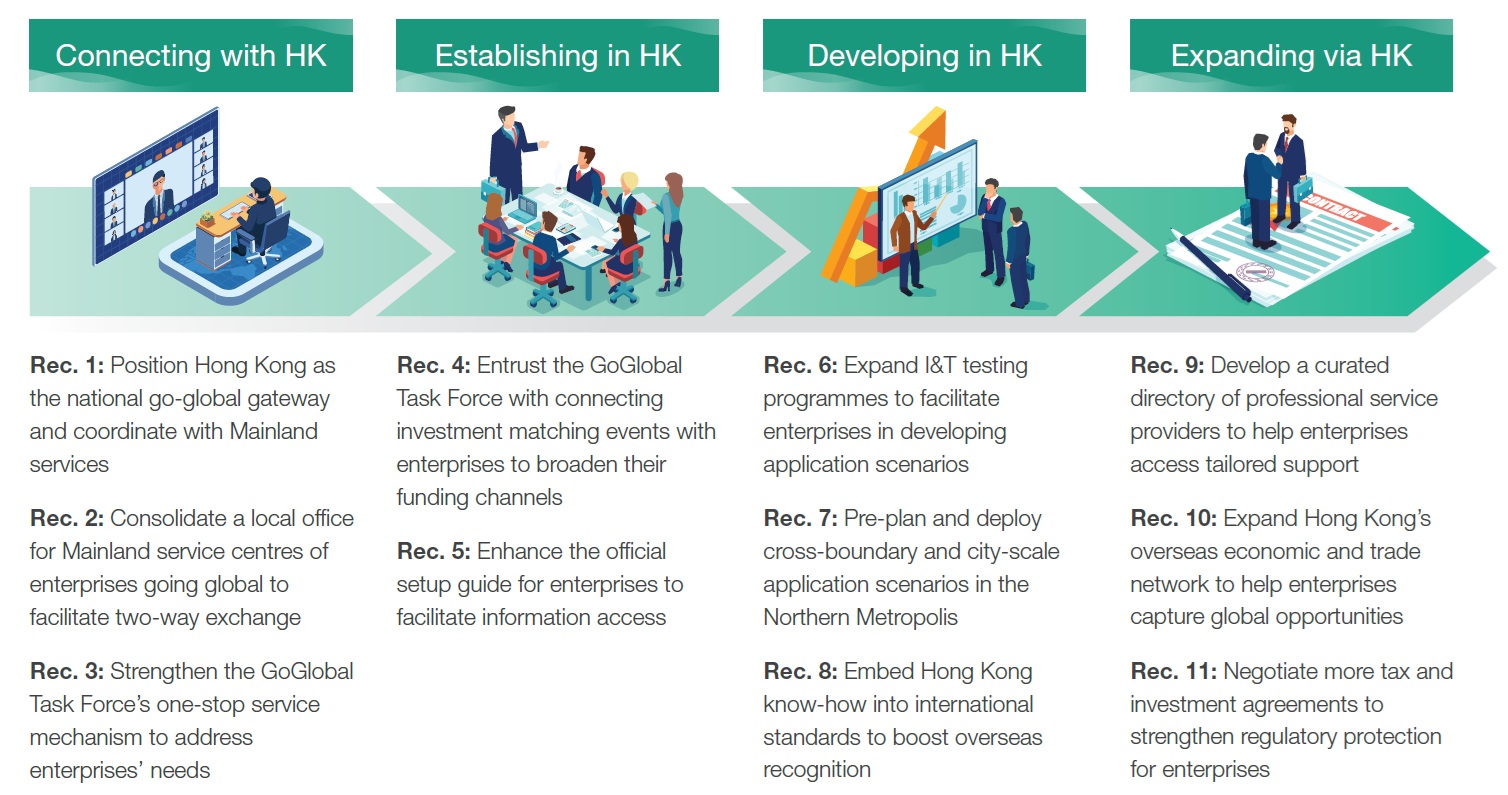
Building on the analysis of Hong Kong’s service advantages and pain points, this report puts forward 11 policy recommendations across four stages of the go-global journey. These include: strengthening the GoGlobal Task Force’s one-stop service mechanism to address enterprises’ needs; enhancing the official setup guide to lower enterprises’ barriers for local establishment and operation; establishing testing mechanisms for more emerging I&T fields, and embedding Hong Kong know-how into more international standards to boost enterprises’ overseas recognition; increasing Hong Kong Trade Development Council and Economic and Trade Offices’ overseas presence, and negotiating more Comprehensive Double Taxation Agreements and Investment Promotion and Protection Agreements in emerging markets to consolidate overseas support and regulatory protection for enterprises.
By combining Hong Kong’s traditional advantages with new momentum from enterprises going global, these policy measures will not only reinforce Hong Kong’s competitive edge as the preferred first stop for Mainland enterprises going global but also position the city as a strategic pillar in the nation’s efforts to build a new development paradigm. Harnessing the wind of national strategy and the strengths of the city’s professional services, Hong Kong can help enterprises navigate the waves and succeed in their go-global journey.




As the national economy enters a new normal, Mainland enterprises are confronting a reality of “go global or lose out”. In support of the national strategy outlined in the 14th and 15th Five-Year Plans to expand high-level opening-up, the 2025 Policy Address announced the establishment of the Task Force on Supporting Mainland Enterprises in Going Global (GoGlobal Task Force). Between 2018 and 2025, Mainland-affiliated companies in Hong Kong grew from 1,591 to 3,090—an increase of 94%—demonstrating Hong Kong’s growing appeal as the preferred platform for enterprises going global.
In light of this, Our Hong Kong Foundation (OHKF) published a research report titled Setting Sail from Hong Kong: A New Era for Enterprises Going Global. By adopting an entrepreneur’s perspective, this report provides a comprehensive analysis of how Hong Kong can improve its one-stop services for enterprises going global.
Enterprises’ needs and Hong Kong’s strengths
To evaluate Hong Kong’s services, this report begins by mapping out enterprises’ go-global journey into four stages: strategic planning, market preparation, business localisation, and overseas expansion. At each stage, enterprises encounter diverse needs such as strategic positioning, overseas corporate financing, product localisation, and legal risk management. Hong Kong’s traditional strengths, including China-savvy, globally-connected professional services, free-flowing and open capital markets, overseas-oriented application scenarios, and internationally-aligned legal framework, are well-placed to meet these needs systematically, providing enterprises with end-to-end support.
Pain points in Hong Kong’s services
Despite Hong Kong’s clear advantages as the preferred first stop for enterprises going global, notable pain points remain throughout the four key stages of the journey: Connecting with Hong Kong, Establishing in Hong Kong, Developing in Hong Kong, and Expanding via Hong Kong. These pain points include inadequate coordination between Hong Kong and the Mainland’s services, limited access to practical information about setting up in Hong Kong, insufficient application scenarios for products and services, and inadequate on-the-ground support and regulatory protection to back enterprises abroad. Such pain points restrict the full realisation of Hong Kong’s potential in providing go-global services.
Four-stage recommendations to develop the preferred first stop for enterprises going global
Building on the analysis of Hong Kong’s service advantages and pain points, this report puts forward 11 policy recommendations across four stages of the go-global journey. These include: strengthening the GoGlobal Task Force’s one-stop service mechanism to address enterprises’ needs; enhancing the official setup guide to lower enterprises’ barriers for local establishment and operation; establishing testing mechanisms for more emerging I&T fields, and embedding Hong Kong know-how into more international standards to boost enterprises’ overseas recognition; increasing Hong Kong Trade Development Council and Economic and Trade Offices’ overseas presence, and negotiating more Comprehensive Double Taxation Agreements and Investment Promotion and Protection Agreements in emerging markets to consolidate overseas support and regulatory protection for enterprises.
By combining Hong Kong’s traditional advantages with new momentum from enterprises going global, these policy measures will not only reinforce Hong Kong’s competitive edge as the preferred first stop for Mainland enterprises going global but also position the city as a strategic pillar in the nation’s efforts to build a new development paradigm. Harnessing the wind of national strategy and the strengths of the city’s professional services, Hong Kong can help enterprises navigate the waves and succeed in their go-global journey.