










Towards a Fit-for-Purpose Mental Health System




Towards a Fit-for-Purpose Mental Health System

The mental health of the Hong Kong population has been worsening over recent years. Local statistics revealed that one in five Hong Kongers experienced a mental health problem and close to 50% showed depressive symptoms. More importantly, persons with common mental disorders, such as depressive disorder and anxiety disorder, have narrow access to psychological services in the public sector.
The burgeoning mental health crisis points to a pressing demand for ongoing review and enhancements to achieve a reoriented mental health system that adheres to a “fit-for-purpose” vision. To ensure more timely and appropriate access to care, we propose that the mental health system must reorient from its current specialist-centric modality toward a primary care-led service model. Notably, we advocate for leveraging community resources to optimise service accessibility. Multi-disciplinary approaches and cross-sectoral efforts will be crucial in bridging formal care with services available in everyday life settings, such as digital space and workplace.
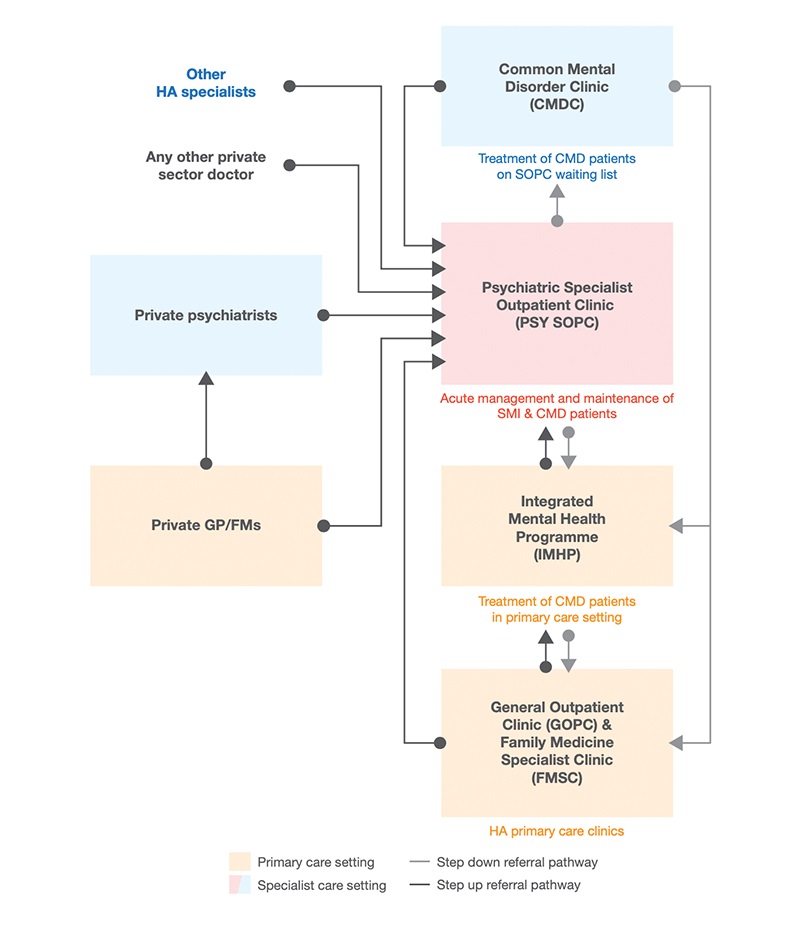
To realise this vision of a community-centric, primary care-led mental health system, efforts are needed to change the existing system structures and to innovate models of care that promote timely access. In particular, we envision the mental health system adopting a stepped care model for psychological therapies that match patients’ needs to the appropriate level of care (Figure 2).
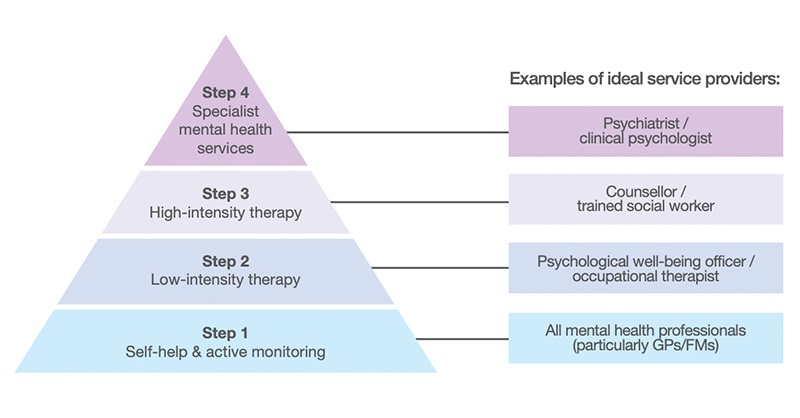
Through interviewing over 70 key stakeholders across medical, social, academic, government and other sectors, conducting two focus groups with mental health services users, and collecting opinions from key service providers in the community through questionnaires, we map the landscape of mental health services, identify the service gaps and challenges in accessing suitable services, and analyse how capacity in the community particularly at the primary care level can be better leveraged for mental health service provision in Hong Kong.
Based on our multi-faceted research, we present five key policy directions:
Hong Kong must optimise service accessibility through current care models, particularly in non-hospital settings.
Hong Kong should strengthen formal care models through a stepped care approach for diverse mental health needs.
Hong Kong should leverage mental health support beyond formal care settings, such as through digital health services and enhancing mental health promotion within the workplace.
Hong Kong must facilitate system-wide integration through exploring the use of a multidisciplinary data communication platform and adopting a system-wide standardised mental health care protocol.
Hong Kong should refine the policymaking and policy execution process, particularly in ensuring clear policy implementation plans.




The mental health of the Hong Kong population has been worsening over recent years. Local statistics revealed that one in five Hong Kongers experienced a mental health problem and close to 50% showed depressive symptoms. More importantly, persons with common mental disorders, such as depressive disorder and anxiety disorder, have narrow access to psychological services in the public sector.
The burgeoning mental health crisis points to a pressing demand for ongoing review and enhancements to achieve a reoriented mental health system that adheres to a “fit-for-purpose” vision. To ensure more timely and appropriate access to care, we propose that the mental health system must reorient from its current specialist-centric modality toward a primary care-led service model. Notably, we advocate for leveraging community resources to optimise service accessibility. Multi-disciplinary approaches and cross-sectoral efforts will be crucial in bridging formal care with services available in everyday life settings, such as digital space and workplace.
To realise this vision of a community-centric, primary care-led mental health system, efforts are needed to change the existing system structures and to innovate models of care that promote timely access. In particular, we envision the mental health system adopting a stepped care model for psychological therapies that match patients’ needs to the appropriate level of care (Figure 2).
Through interviewing over 70 key stakeholders across medical, social, academic, government and other sectors, conducting two focus groups with mental health services users, and collecting opinions from key service providers in the community through questionnaires, we map the landscape of mental health services, identify the service gaps and challenges in accessing suitable services, and analyse how capacity in the community particularly at the primary care level can be better leveraged for mental health service provision in Hong Kong.
Based on our multi-faceted research, we present five key policy directions:
Hong Kong must optimise service accessibility through current care models, particularly in non-hospital settings.
Hong Kong should strengthen formal care models through a stepped care approach for diverse mental health needs.
Hong Kong should leverage mental health support beyond formal care settings, such as through digital health services and enhancing mental health promotion within the workplace.
Hong Kong must facilitate system-wide integration through exploring the use of a multidisciplinary data communication platform and adopting a system-wide standardised mental health care protocol.
Hong Kong should refine the policymaking and policy execution process, particularly in ensuring clear policy implementation plans.