










Strategic Land Development for Jobs: From Brownfields to Modern Logistics




Strategic Land Development for Jobs: From Brownfields to Modern Logistics

Our Hong Kong Foundation (OHKF) published its latest Land & Housing Policy Research Report, “Strategic Land Development for Jobs: From Brownfields to Modern Logistics”.
The report pointed out that the Government’s lack of a strategic economic and industrial blueprint, coupled with inadequate infrastructure investment, had led to an acute land shortage for the logistics industry. The outlook for our logistic industry will be precarious should the Government fail to provide timely policy support.
All sectors of the logistics industry, including the maritime and port industries as well as the airfreight sector, are constrained by the shortage of industrial space. Take the maritime and port industry for example: Hong Kong Port has the smallest yard area as a proportion of throughput among the world’s busiest port. It is relegated by competing ports in the region, and saw its global ranking dropping from the first to the eighth place. In addition, OHKF’s analysis shows that at present, more than 40% of the port back-up land near the Kwai Tsing container terminals has not been fully utilized.
While the trading and logistics industry’s GDP contribution grew by 51% from 2009 to 2018, built-up industrial land only recorded a meagre increase of 8%. There had even been a supply vacuum in the completion of private storage. At the same time, existing flatted factories, which were designed in the old industrial era, have long failed to meet the market’s needs. The tight supply of industrial land in Hong Kong and the persistently low vacancy rate have inevitably pushed up rents.
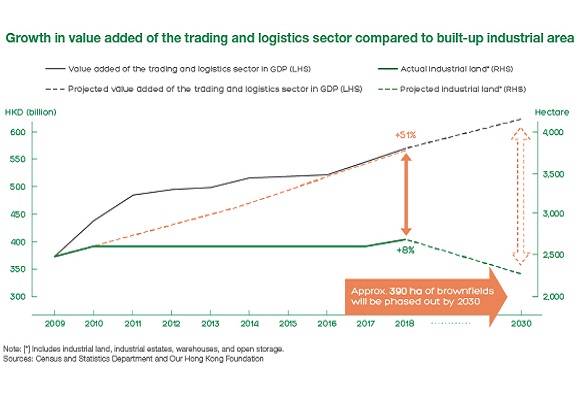
Under-supply of industrial space in has prompted logistics operators to turn to affordable space in the New Territories. This gives rise to the emergence of brownfield, which is often misunderstood by the society. Currently, 46% of the 1,414 hectares of active brownfield sites are occupied by logistics-related industries. According to OHKF estimates, there will be 390 hectares of brownfields being reapportioned for housing and other development by 2030.
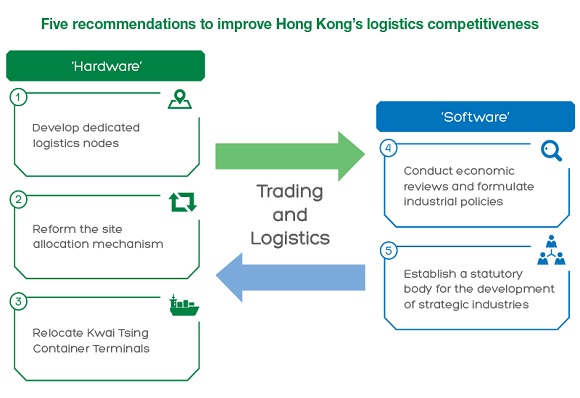
In view of an alarming outlook for one of the four key industries in the city, OHKF presents a set of five policy recommendations to address the current challenges. OHKF urges the Government to provide adequate land and facilities in a timely manner, and to establish an effective governance structure in support of our strategic industries. Only by doing so can we provide a way forward for sustainable development of the logistics industry.




Our Hong Kong Foundation (OHKF) published its latest Land & Housing Policy Research Report, “Strategic Land Development for Jobs: From Brownfields to Modern Logistics”.
The report pointed out that the Government’s lack of a strategic economic and industrial blueprint, coupled with inadequate infrastructure investment, had led to an acute land shortage for the logistics industry. The outlook for our logistic industry will be precarious should the Government fail to provide timely policy support.
All sectors of the logistics industry, including the maritime and port industries as well as the airfreight sector, are constrained by the shortage of industrial space. Take the maritime and port industry for example: Hong Kong Port has the smallest yard area as a proportion of throughput among the world’s busiest port. It is relegated by competing ports in the region, and saw its global ranking dropping from the first to the eighth place. In addition, OHKF’s analysis shows that at present, more than 40% of the port back-up land near the Kwai Tsing container terminals has not been fully utilized.
While the trading and logistics industry’s GDP contribution grew by 51% from 2009 to 2018, built-up industrial land only recorded a meagre increase of 8%. There had even been a supply vacuum in the completion of private storage. At the same time, existing flatted factories, which were designed in the old industrial era, have long failed to meet the market’s needs. The tight supply of industrial land in Hong Kong and the persistently low vacancy rate have inevitably pushed up rents.
Under-supply of industrial space in has prompted logistics operators to turn to affordable space in the New Territories. This gives rise to the emergence of brownfield, which is often misunderstood by the society. Currently, 46% of the 1,414 hectares of active brownfield sites are occupied by logistics-related industries. According to OHKF estimates, there will be 390 hectares of brownfields being reapportioned for housing and other development by 2030.
In view of an alarming outlook for one of the four key industries in the city, OHKF presents a set of five policy recommendations to address the current challenges. OHKF urges the Government to provide adequate land and facilities in a timely manner, and to establish an effective governance structure in support of our strategic industries. Only by doing so can we provide a way forward for sustainable development of the logistics industry.