





OHKF Advocates Positioning Hong Kong as the Preferred First Stop for Mainland Enterprises Going Global




OHKF Advocates Positioning Hong Kong as the Preferred First Stop for Mainland Enterprises Going Global

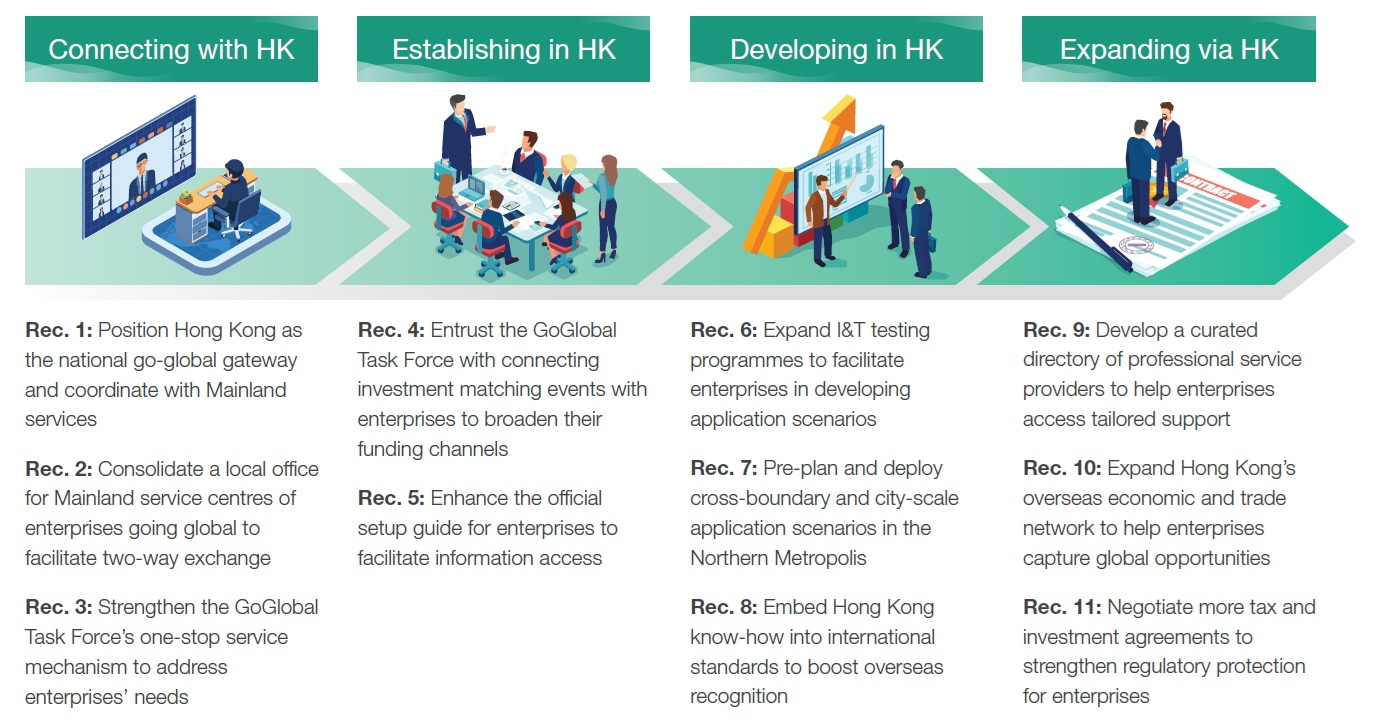
[28 January 2026, Hong Kong] As the national economy enters a new normal, Mainland enterprises are confronting a reality of “go global or lose out.” As a “super-connector,” Hong Kong’s role must evolve with the times. Our Hong Kong Foundation (OHKF) today released a policy research report titled “Setting Sail from Hong Kong: A New Era for Enterprises Going Global” (the report). The report proposes a four-stage framework for going global—Connecting with Hong Kong, Establishing in Hong Kong, Developing in Hong Kong, and Expanding via Hong Kong and puts forward 11 concrete policy recommendations addressing service pain points at each stage. The aim is to position Hong Kong as the preferred first stop for Mainland enterprises going global.
OHKF points out that, compared to entering different target markets directly, setting up a first stop is more conducive for enterprises to comprehensively manage overseas capital, research and development activities, and human resources. With its traditional advantages, such as free-flowing and open capital markets and extensive trade networks, Hong Kong is the ideal location for enterprises to establish this first stop. The report suggests that the HKSAR Government optimise service quality at every stage of the go global journey—from Connecting with Hong Kong to Expanding via Hong Kong—through adopting an entrepreneur’s perspective.
Stage 1: Connecting with Hong Kong—Coordinating Services between Hong Kong and Mainland and Optimising Engagement Mechanism
During the Connecting with Hong Kong stage, service gaps are evident in two areas: enterprises’ engagement with Hong Kong, and the GoGlobal Task Force’s internal coordination mechanism. Currently, while many Mainland cities have established service centres of enterprises going global, their collaboration with Hong Kong’s service institutions remains limited, leaving enterprises without a systematic channel to understand Hong Kong’s policies. Moreover, the GoGlobal Task Force requires better coordination to provide one-stop services, thereby efficiently responding to inquiries from enterprises seeking to establish a presence in Hong Kong.
To strengthen communication and collaboration, the report first recommends strategically positioning Hong Kong as the national gateway for enterprises going global. This would enhance the synergy between the Mainland as an innovation incubator and Hong Kong as an international showcase platform. To achieve this, the Government should establish a consolidated local office for Mainland service centres of enterprises going global, thereby improving enterprises’ engagement with Hong Kong. Moreover, the GoGlobal Task Force should strengthen its one-stop service mechanism, which includes clarifying common procedural questions about establishing in Hong Kong and addressing complex business needs through cross-departmental collaboration.
Stage 2: Establishing in Hong Kong—Improving Guidance and Support to Resolve Information Gaps
Upon entering the Establishing in Hong Kong stage, enterprises face the challenge of limited information. Surveys show that enterprises often lack clear access to information on company registration, office space, and professional services, hindering their efforts to quickly set up in the city.
To facilitate better access to information, the report recommends enhancing the official setup guide for enterprises to ease information access. Invest Hong Kong could enhance the design of its Step-by-Step Guide to Invest in Hong Kong by incorporating key Hong Kong advantage metrics to strengthen outreach, while supplementing it with information on local business management services, such as venues, legal, financial, and taxation advisory services. Furthermore, the new guide should be upgraded into an interactive e-document, linking to relevant government resources such as the Hong Kong Talent Engage’s Talent Admission Scheme Quick Guide and the curated directory of professional services. Through one-stop information integration, this will lower enterprises’ barriers to local establishment and operation.
Stage 3: Developing in Hong Kong—Expanding Application Scenarios and Aligning with International Standards
After entering the Developing in Hong Kong stage, enterprises aim to leverage Hong Kong’s diverse, complex, and internationalised application scenarios to refine their products and services and establish international best practices. Although the Government has launched innovation and technology (I&T) testing mechanisms such as the Low-Altitude Economy (LAE) Regulatory Sandbox, demand for innovative application scenarios—especially complex cross-boundary and city-scale applications—remains insufficiently met.
To expand application scenarios, the report recommends establishing testing mechanisms for more emerging I&T fields to pilot cutting-edge technologies in Hong Kong. Necessary infrastructure should also be planned in the Northern Metropolis to support cross-boundary and city-scale application scenarios. Building on these tests, the Government should draw on the LAE Regulatory Sandbox’s experience in global standard-setting and embed Hong Kong know-how into more international standards. This would allow participating enterprises to go global with the labels of “Mainland DNA,” “Hong Kong Value-add,” and “International Certification,” thereby enhancing their overseas recognition.
Stage 4: Expanding via Hong Kong—Expanding Economic and Trade Network and Strengthening Regulatory Protection
Once enterprises mature locally, they will enter the Expanding via Hong Kong and step into unfamiliar markets. They often lack on-the-ground support to manage risks, and Hong Kong’s economic and trade protections remain insufficient in uncharted territory.
To strengthen overseas protection for enterprises, the report recommends expanding Hong Kong’s overseas economic and trade network by increasing the overseas presence of the Hong Kong Trade Development Council and Economic and Trade Offices, and by connecting with overseas Chinese networks. Beyond enhancing service networks, the Government should negotiate more Comprehensive Double Taxation Agreements (CDTAs) and Investment Promotion and Protection Agreements (IPPAs) with emerging markets such as Latin America, Eastern Europe, Central Asia, and Africa to improve regulatory protection for enterprises.
By combining Hong Kong’s traditional advantages with new momentum from enterprises going global, these policy measures will not only reinforce Hong Kong’s competitive edge as the preferred first stop for Mainland enterprises going global but also position the city as a strategic pillar in the nation’s efforts to build a new development paradigm. Harnessing the wind of national strategy and the strengths of the city’s professional services, Hong Kong can help enterprises navigate the waves and succeed in their go-global journey.
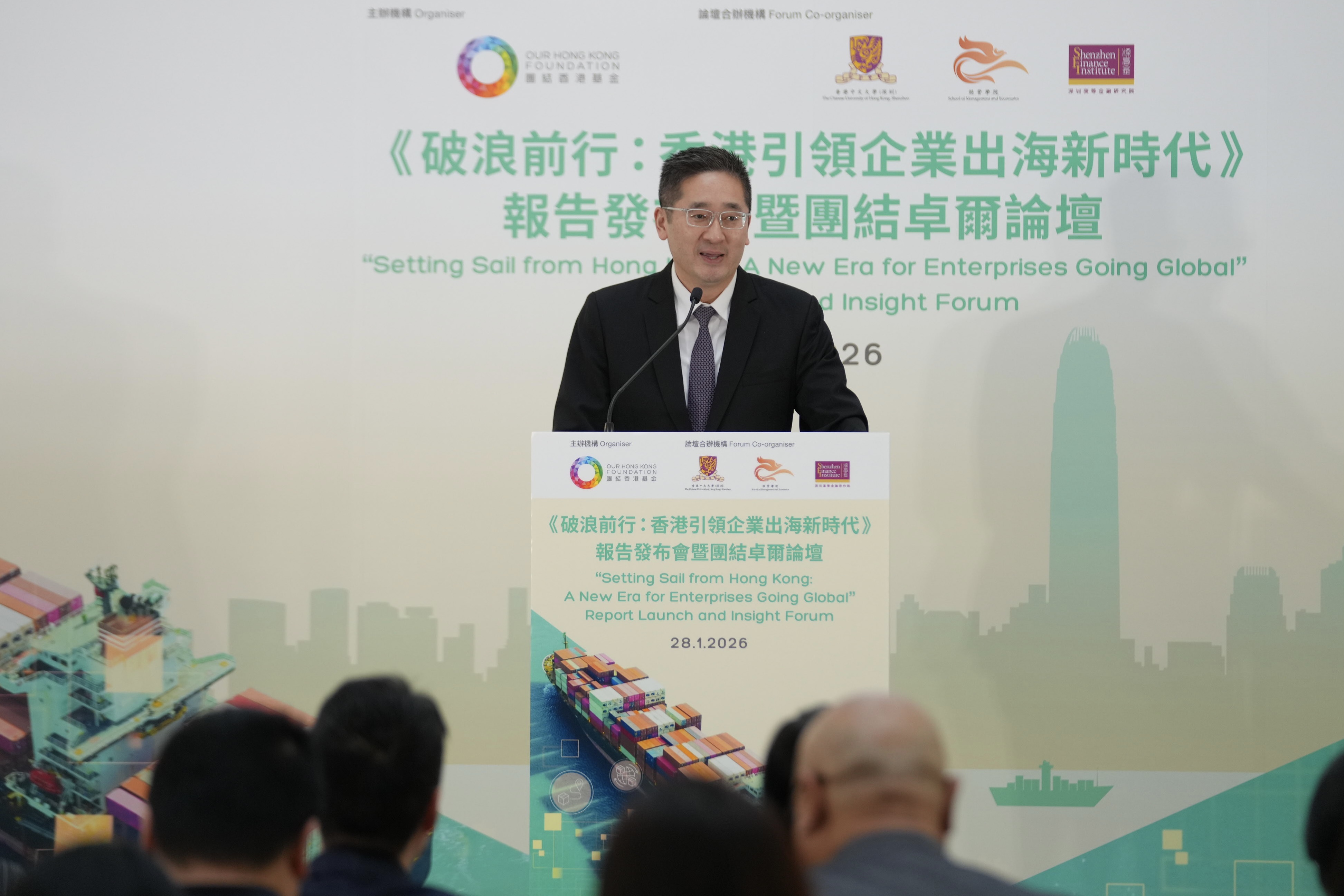
Dr Bernard Chan, Under Secretary for Commerce and Economic Development of the Government of the HKSAR, stated: “Hong Kong is at a critical juncture. We are not only the hub for enterprises going global from the Guangdong-Hong Kong-Macao Greater Bay Area, but also the national gateway for companies across Chinese Mainland to access the world. The HKSAR Government is fully committed to advancing this agenda, including the establishment of The GoGlobal Task Force, the official launch of The Hong Kong Professional Services GoGlobal Platform. These efforts are designed to connect Mainland enterprises with more high-potential markets, making Hong Kong the starting point for Mainland companies to expand globally, while injecting substantial momentum into Hong Kong's economic growth.”
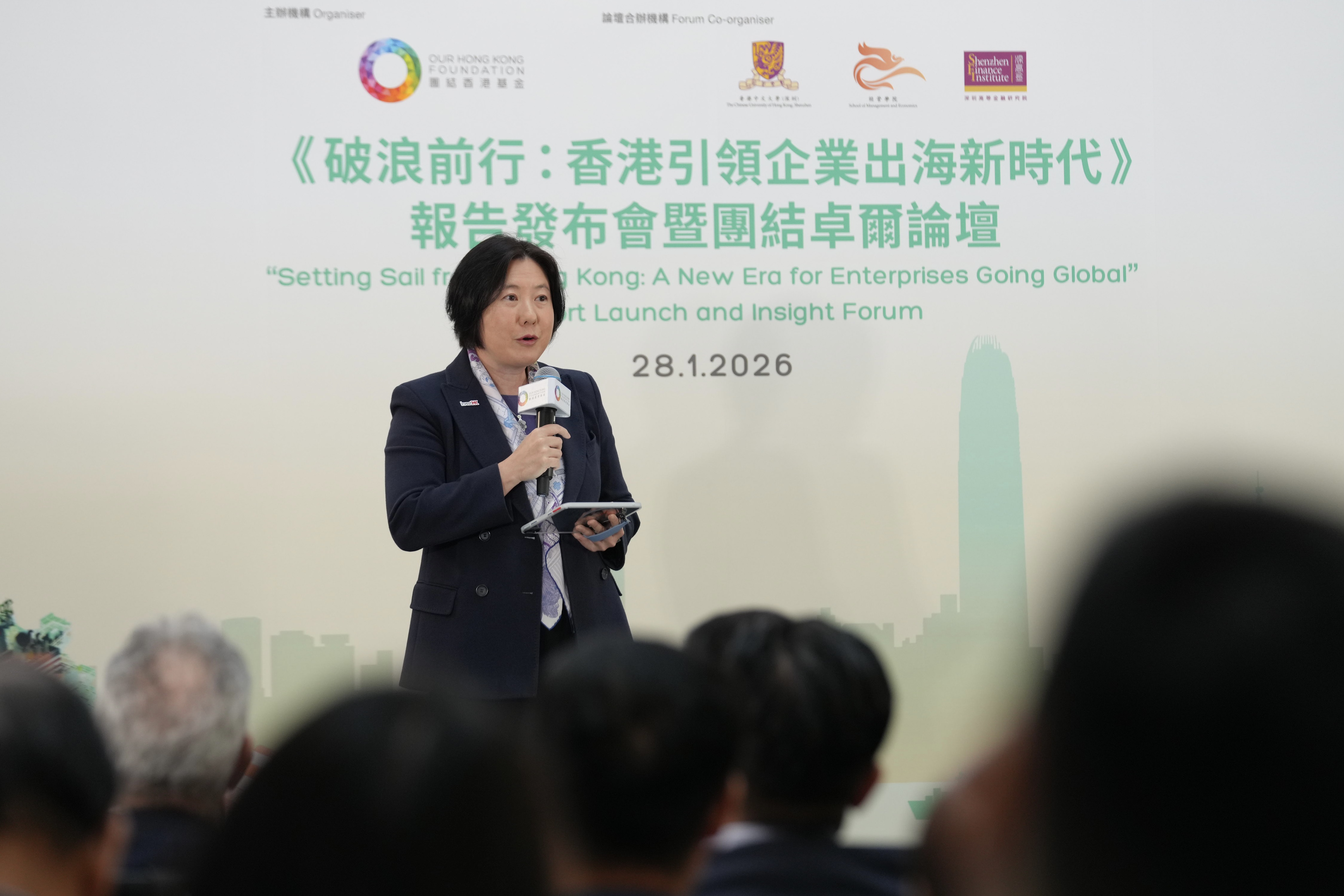
Ms Alpha Lau, Director-General of Investment Promotion at InvestHK, stated in her keynote speech: “In 2025, the number of companies in Hong Kong with parent companies from the Chinese Mainland or overseas surpassed 11,000, underscoring strong confidence in our city as a strategic springboard for global expansion. At InvestHK, we transform Hong Kong’s unique advantages into practical, end-to-end support. We help enterprises navigate risks, structure investments, and align with international standards, ensuring they not only go global, but truly thrive on the global stage. Our mission is to anchor high‑value functions — from R&D to intellectual property — in Hong Kong, enabling businesses to build resilient, scalable value chains with our city as their long‑term partner.”
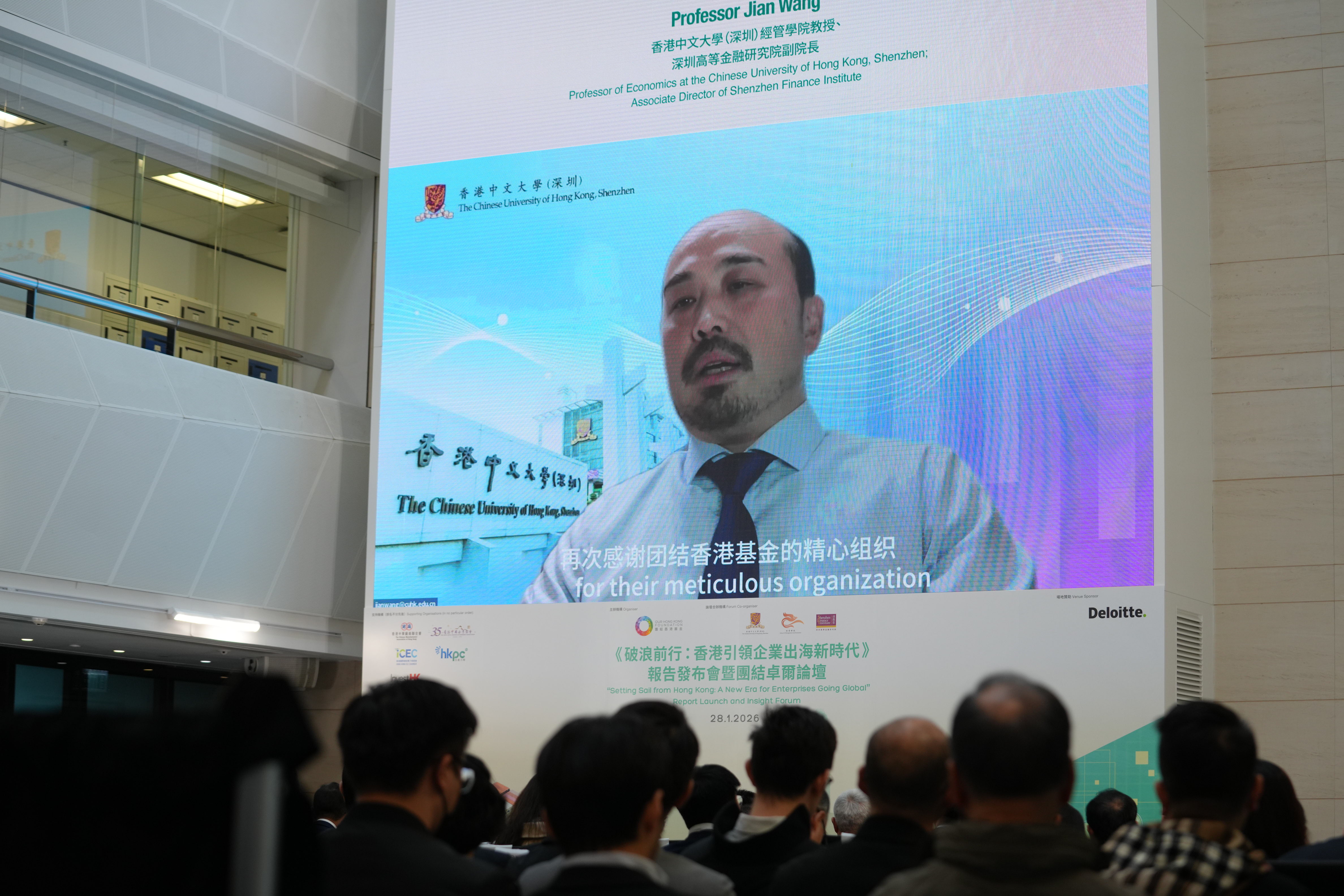
Professor Wang Jian, Professor of Economics at the Chinese University of Hong Kong, Shenzhen; Associate Director of Shenzhen Finance Institute, stated: “We will continue to promote corporate globalization as its core. We will help more Chinese companies break through barriers and move forward through more high- quality research results and more professional talent cultivation. Let Hong Kong give full play to its ‘super connector’ advantage, deeply integrate whit the Mainland’s industrial advantages, to jointly achieve a global win-win situation.”
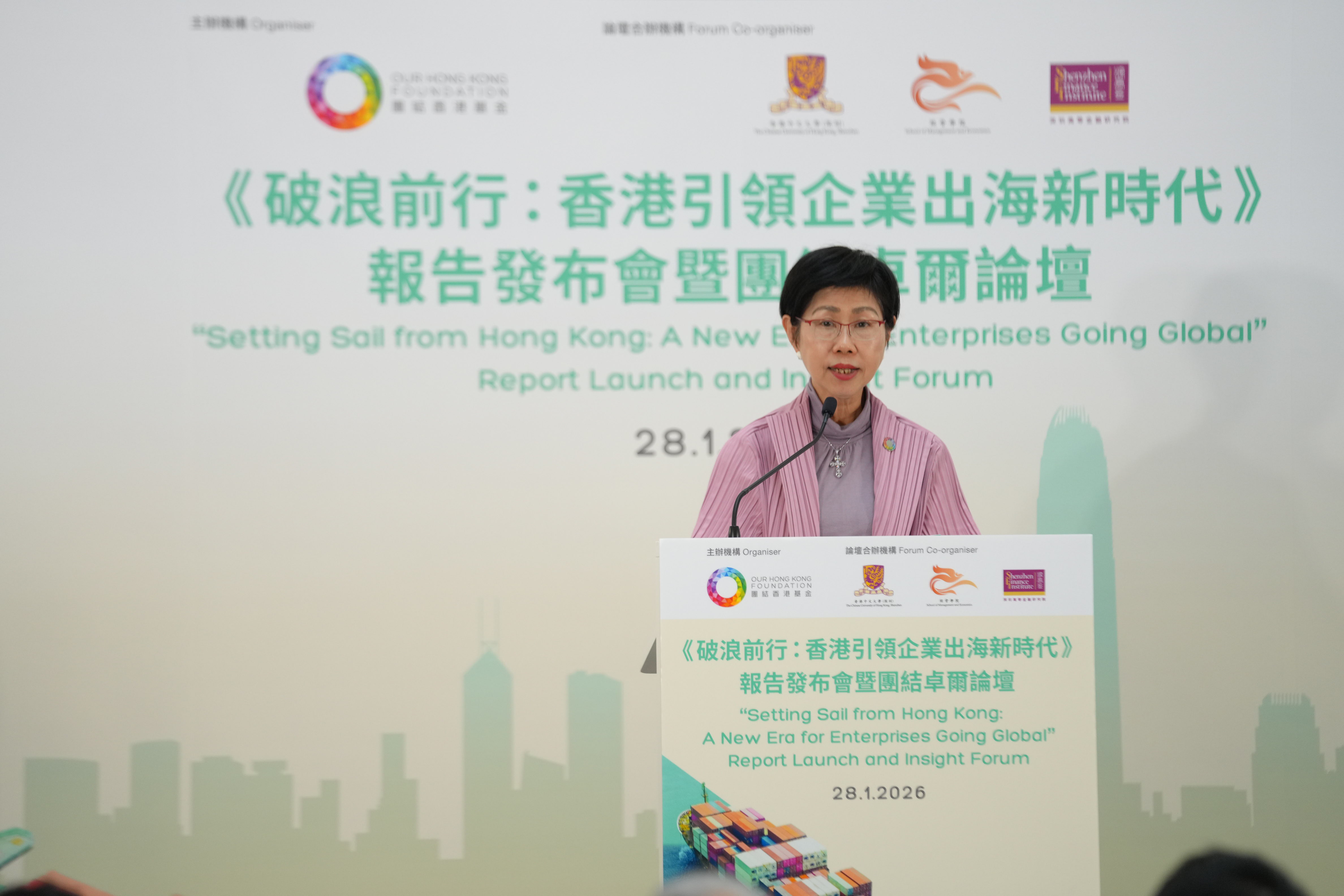
Dr Jane Lee, President of OHKF, stated: “Positioning Hong Kong as the national gateway for enterprises going global is fundamentally about deeply integrating resources and services from both sides, achieving an organic amalgamation of 'Mainland innovation incubation' and 'Hong Kong international empowerment.' This is not merely a service upgrade but an institutional innovation that will establish Hong Kong as a strategic pivot for the nation's high-level opening-up and the building of a new development paradigm.”
Mr Ryan Ip, Vice President of OHKF and Executive Director of PPI, stated: “The four-stage framework for going global outlined in the report is essentially a journey-centric framework that restructures Hong Kong’s service ecosystem around an enterprise’s go global cycle. This framework integrates previously fragmented service elements into a coherent support system that accompanies enterprises throughout their go-global journey. It systematically expands and elevates the value proposition of Hong Kong's services, truly enabling the city to walk alongside enterprises from start to finish as they set sail toward distant horizons.”
Mr Jason Leung, Assistant Research Director, Head of Land & Housing of OHKF, stated: “Supporting enterprises in going global not only opens up more diverse business areas for Hong Kong’s professional service institutions but will also encourage Mainland and Hong Kong companies to jointly venture into the global market, strengthening the overall competitiveness of Chinese enterprises in the international market. This process will ultimately translate into a powerful driving force for Hong Kong’s industry upgrading, job creation, and economic growth.”
Setting Sail from Hong Kong: A New Era for Enterprises Going Global
Full Report: https://bit.ly/4jvLygF
Executive Summary: https://bit.ly/4abIJhO
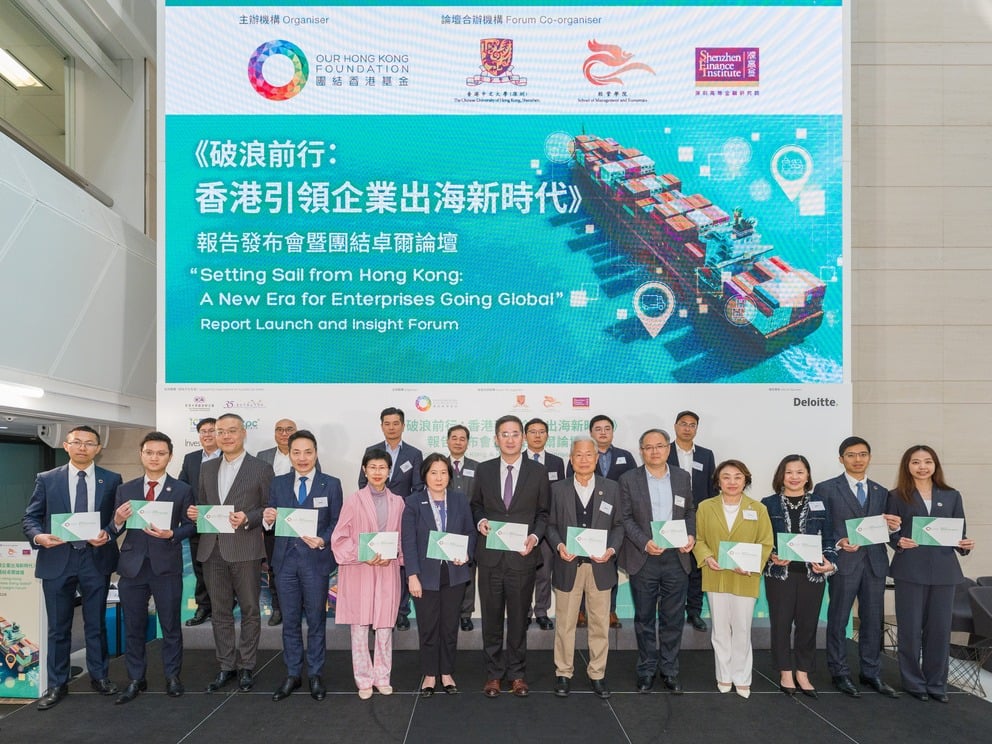
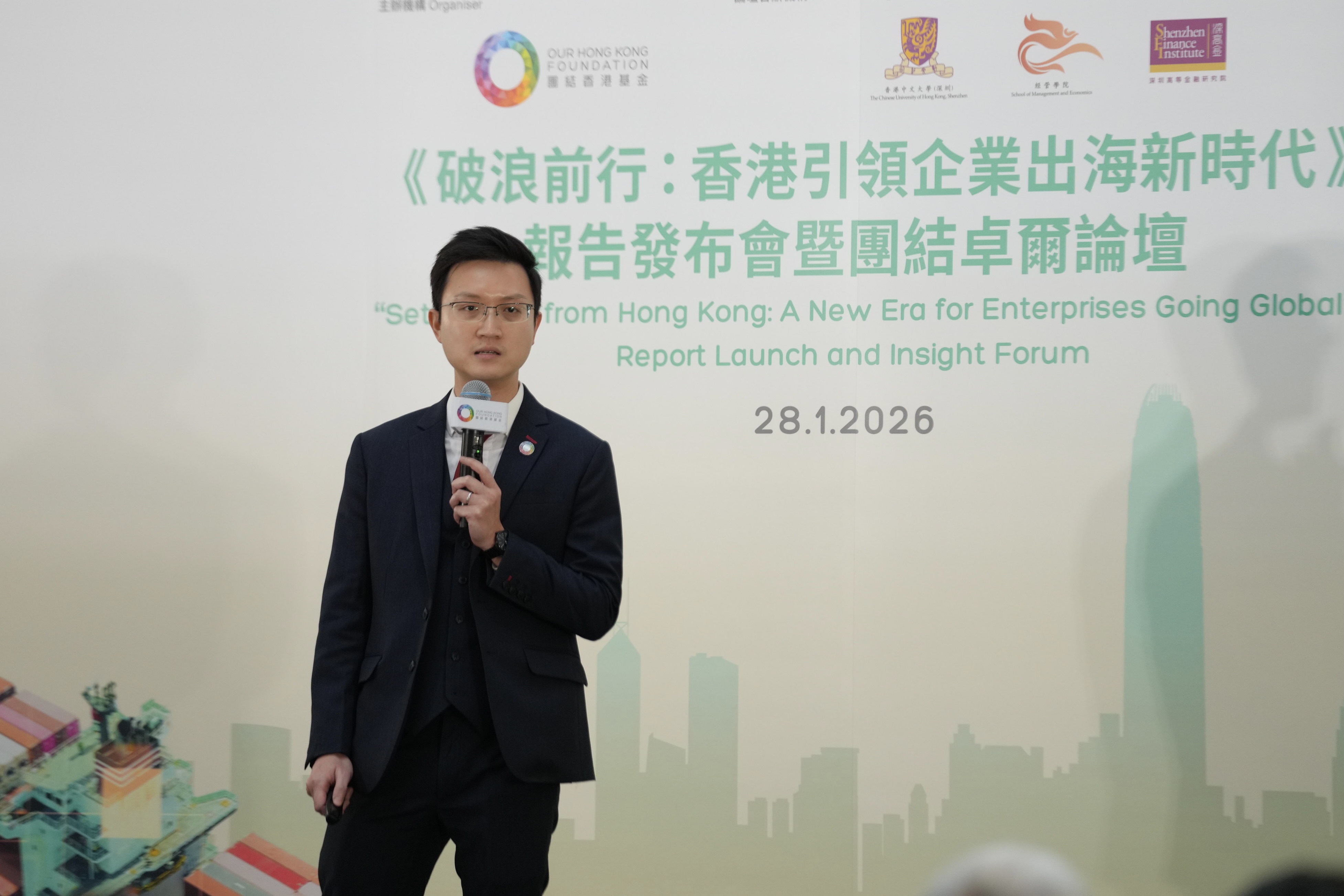
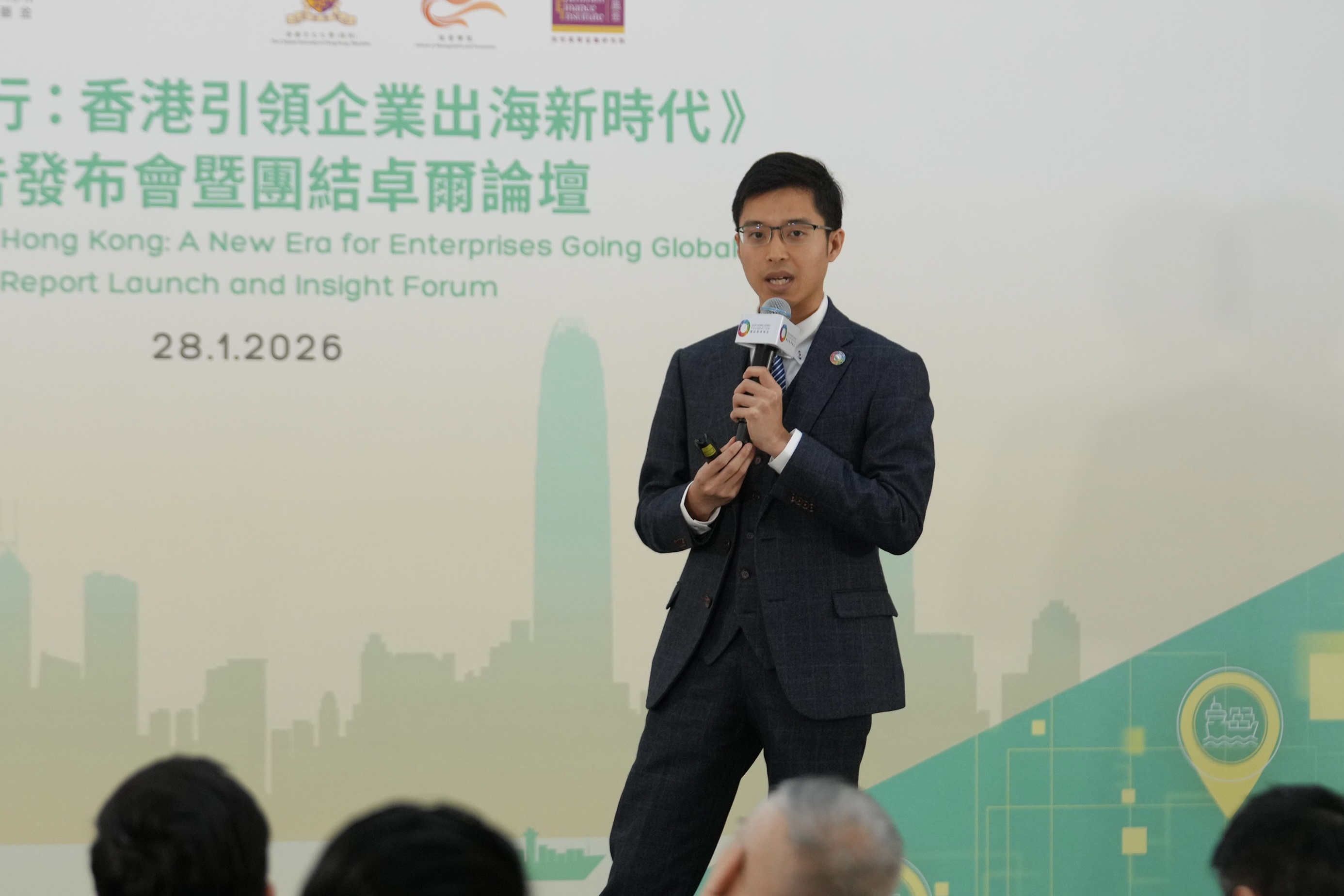
OHKF will also host an Insight Forum with the Chinese University of Hong Kong, Shenzhen. Under the theme “The New Era of Enterprises Going Global – Hong Kong as a Strategic Gateway”, government officials, professional service providers, academics, and investors will explore how Hong Kong can further leverage its strengths in connecting with the Chinese Mainland and the world to support the high-quality global expansion of Chinese enterprises.
The Forum invited Professor Wang Jian, Professor of Economics at the Chinese University of Hong Kong, Shenzhen; Associate Director of Shenzhen Finance Institute, to present a keynote report titled “Industry Synergy Toward Shared Success: An Overview of China’s Key Industrial Clusters Going Global” Report Presentation.
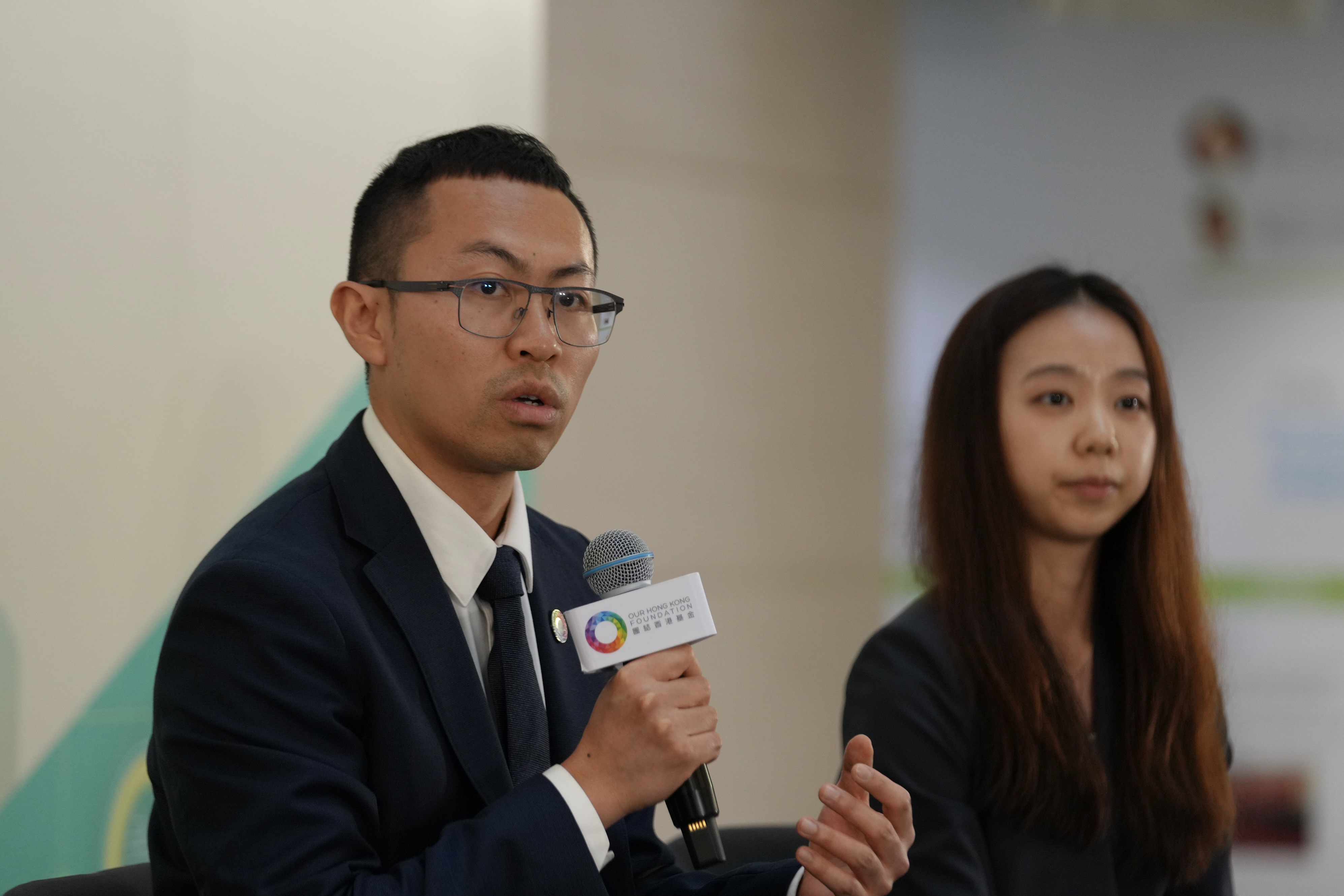
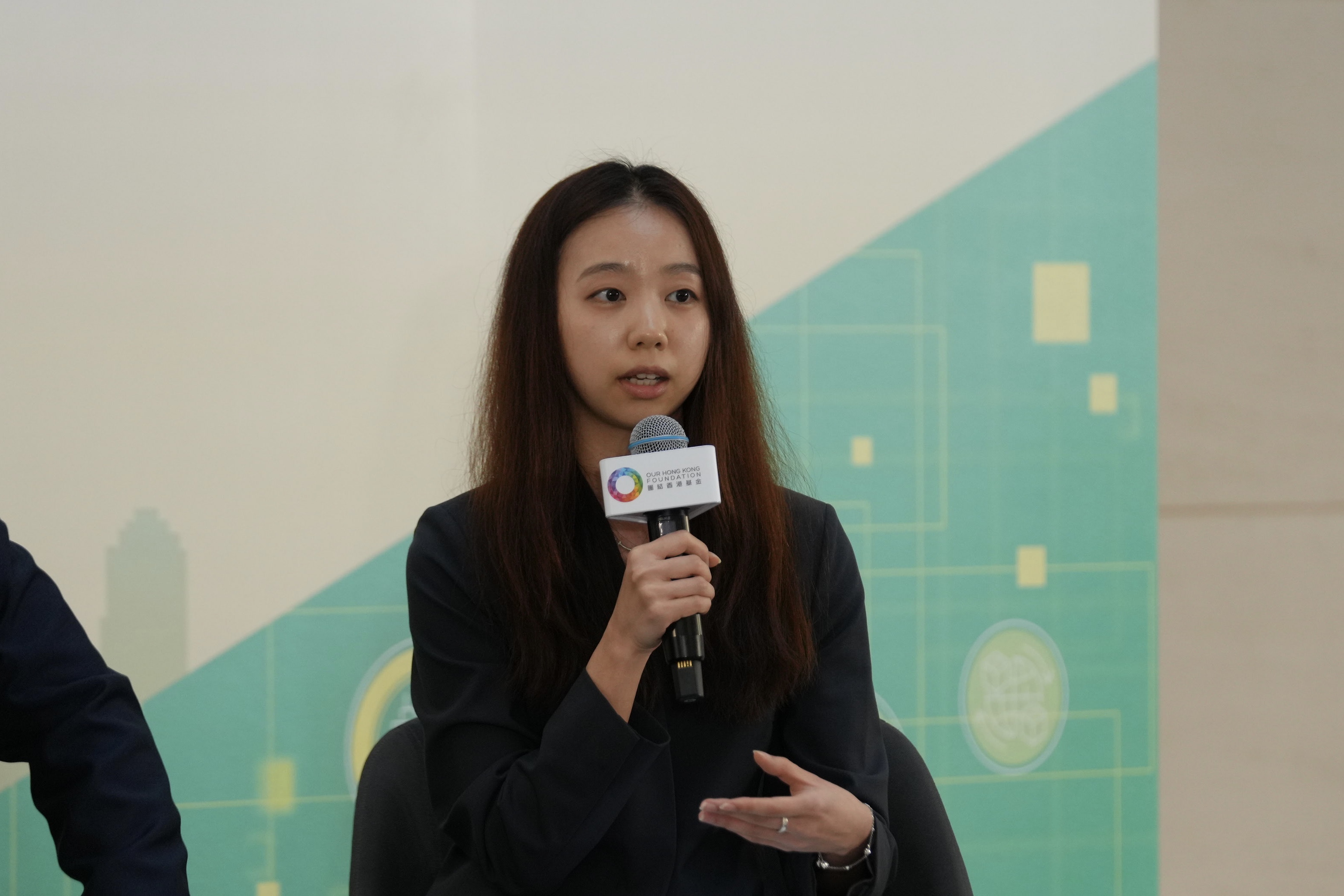
Two roundtable discussions were held to discuss Hong Kong’s advantages and the global layout of Mainland enterprises.。
The first roundtable, titled “How can Hong Kong leverage its strengths to become the premium platform for Mainland enterprises going global?,” featured Mr Edmond Lai, Chief Digital Officer of the Hong Kong Productivity Council; Mr Edward Au, Southern Region Managing Partner of Deloitte China; Ms Candy Chan, Team Lead Partner of HK IPO Practice of King & Wood Mallesons; and Mr Simon Yu, Vice President (Global Sales and Marketing) of UISEE Technology. The session was moderated by Mr Ryan Ip, Vice President of OHKF and Executive Director of PPI.
The second roundtable, titled “The Strategic Value of Hong Kong as a Gateway for the Globalisation of Chinese Pharma and Medical Device Companies,” featured Professor Chenzhong Li, X.Q. Deng Presidential Chair Professor at the Chinese University of Hong Kong, Shenzhen; Fellow Member of the Canadian Academy of Engineering; Mr Tianquan Li , Co-founder and Vice President of Yaozh.com; Executive Deputy Dean of Chongqing Research Institute for Pharmaceutical Big Data Applications ; Mr Xiaocheng Zheng, Board Secretary of Allmed Medical Products Co., Ltd.; and Dr Changgui Dai , Chief Operating Officer (COO) and Founder of Signet Therapeutics (Shenzhen) Co., Ltd.; Deputy Director of the Cancer Targeted Therapy R&D Center, Research Institute of Tsinghua University in Shenzhen. The session was moderated by Professor Ma Xufei, Chairman of the Department of Management, The Chinese University of Hong Kong (CUHK).



[28 January 2026, Hong Kong] As the national economy enters a new normal, Mainland enterprises are confronting a reality of “go global or lose out.” As a “super-connector,” Hong Kong’s role must evolve with the times. Our Hong Kong Foundation (OHKF) today released a policy research report titled “Setting Sail from Hong Kong: A New Era for Enterprises Going Global” (the report). The report proposes a four-stage framework for going global—Connecting with Hong Kong, Establishing in Hong Kong, Developing in Hong Kong, and Expanding via Hong Kong and puts forward 11 concrete policy recommendations addressing service pain points at each stage. The aim is to position Hong Kong as the preferred first stop for Mainland enterprises going global.
OHKF points out that, compared to entering different target markets directly, setting up a first stop is more conducive for enterprises to comprehensively manage overseas capital, research and development activities, and human resources. With its traditional advantages, such as free-flowing and open capital markets and extensive trade networks, Hong Kong is the ideal location for enterprises to establish this first stop. The report suggests that the HKSAR Government optimise service quality at every stage of the go global journey—from Connecting with Hong Kong to Expanding via Hong Kong—through adopting an entrepreneur’s perspective.
Stage 1: Connecting with Hong Kong—Coordinating Services between Hong Kong and Mainland and Optimising Engagement Mechanism
During the Connecting with Hong Kong stage, service gaps are evident in two areas: enterprises’ engagement with Hong Kong, and the GoGlobal Task Force’s internal coordination mechanism. Currently, while many Mainland cities have established service centres of enterprises going global, their collaboration with Hong Kong’s service institutions remains limited, leaving enterprises without a systematic channel to understand Hong Kong’s policies. Moreover, the GoGlobal Task Force requires better coordination to provide one-stop services, thereby efficiently responding to inquiries from enterprises seeking to establish a presence in Hong Kong.
To strengthen communication and collaboration, the report first recommends strategically positioning Hong Kong as the national gateway for enterprises going global. This would enhance the synergy between the Mainland as an innovation incubator and Hong Kong as an international showcase platform. To achieve this, the Government should establish a consolidated local office for Mainland service centres of enterprises going global, thereby improving enterprises’ engagement with Hong Kong. Moreover, the GoGlobal Task Force should strengthen its one-stop service mechanism, which includes clarifying common procedural questions about establishing in Hong Kong and addressing complex business needs through cross-departmental collaboration.
Stage 2: Establishing in Hong Kong—Improving Guidance and Support to Resolve Information Gaps
Upon entering the Establishing in Hong Kong stage, enterprises face the challenge of limited information. Surveys show that enterprises often lack clear access to information on company registration, office space, and professional services, hindering their efforts to quickly set up in the city.
To facilitate better access to information, the report recommends enhancing the official setup guide for enterprises to ease information access. Invest Hong Kong could enhance the design of its Step-by-Step Guide to Invest in Hong Kong by incorporating key Hong Kong advantage metrics to strengthen outreach, while supplementing it with information on local business management services, such as venues, legal, financial, and taxation advisory services. Furthermore, the new guide should be upgraded into an interactive e-document, linking to relevant government resources such as the Hong Kong Talent Engage’s Talent Admission Scheme Quick Guide and the curated directory of professional services. Through one-stop information integration, this will lower enterprises’ barriers to local establishment and operation.
Stage 3: Developing in Hong Kong—Expanding Application Scenarios and Aligning with International Standards
After entering the Developing in Hong Kong stage, enterprises aim to leverage Hong Kong’s diverse, complex, and internationalised application scenarios to refine their products and services and establish international best practices. Although the Government has launched innovation and technology (I&T) testing mechanisms such as the Low-Altitude Economy (LAE) Regulatory Sandbox, demand for innovative application scenarios—especially complex cross-boundary and city-scale applications—remains insufficiently met.
To expand application scenarios, the report recommends establishing testing mechanisms for more emerging I&T fields to pilot cutting-edge technologies in Hong Kong. Necessary infrastructure should also be planned in the Northern Metropolis to support cross-boundary and city-scale application scenarios. Building on these tests, the Government should draw on the LAE Regulatory Sandbox’s experience in global standard-setting and embed Hong Kong know-how into more international standards. This would allow participating enterprises to go global with the labels of “Mainland DNA,” “Hong Kong Value-add,” and “International Certification,” thereby enhancing their overseas recognition.
Stage 4: Expanding via Hong Kong—Expanding Economic and Trade Network and Strengthening Regulatory Protection
Once enterprises mature locally, they will enter the Expanding via Hong Kong and step into unfamiliar markets. They often lack on-the-ground support to manage risks, and Hong Kong’s economic and trade protections remain insufficient in uncharted territory.
To strengthen overseas protection for enterprises, the report recommends expanding Hong Kong’s overseas economic and trade network by increasing the overseas presence of the Hong Kong Trade Development Council and Economic and Trade Offices, and by connecting with overseas Chinese networks. Beyond enhancing service networks, the Government should negotiate more Comprehensive Double Taxation Agreements (CDTAs) and Investment Promotion and Protection Agreements (IPPAs) with emerging markets such as Latin America, Eastern Europe, Central Asia, and Africa to improve regulatory protection for enterprises.
By combining Hong Kong’s traditional advantages with new momentum from enterprises going global, these policy measures will not only reinforce Hong Kong’s competitive edge as the preferred first stop for Mainland enterprises going global but also position the city as a strategic pillar in the nation’s efforts to build a new development paradigm. Harnessing the wind of national strategy and the strengths of the city’s professional services, Hong Kong can help enterprises navigate the waves and succeed in their go-global journey.
Dr Bernard Chan, Under Secretary for Commerce and Economic Development of the Government of the HKSAR, stated: “Hong Kong is at a critical juncture. We are not only the hub for enterprises going global from the Guangdong-Hong Kong-Macao Greater Bay Area, but also the national gateway for companies across Chinese Mainland to access the world. The HKSAR Government is fully committed to advancing this agenda, including the establishment of The GoGlobal Task Force, the official launch of The Hong Kong Professional Services GoGlobal Platform. These efforts are designed to connect Mainland enterprises with more high-potential markets, making Hong Kong the starting point for Mainland companies to expand globally, while injecting substantial momentum into Hong Kong's economic growth.”
Ms Alpha Lau, Director-General of Investment Promotion at InvestHK, stated in her keynote speech: “In 2025, the number of companies in Hong Kong with parent companies from the Chinese Mainland or overseas surpassed 11,000, underscoring strong confidence in our city as a strategic springboard for global expansion. At InvestHK, we transform Hong Kong’s unique advantages into practical, end-to-end support. We help enterprises navigate risks, structure investments, and align with international standards, ensuring they not only go global, but truly thrive on the global stage. Our mission is to anchor high‑value functions — from R&D to intellectual property — in Hong Kong, enabling businesses to build resilient, scalable value chains with our city as their long‑term partner.”
Professor Wang Jian, Professor of Economics at the Chinese University of Hong Kong, Shenzhen; Associate Director of Shenzhen Finance Institute, stated: “We will continue to promote corporate globalization as its core. We will help more Chinese companies break through barriers and move forward through more high- quality research results and more professional talent cultivation. Let Hong Kong give full play to its ‘super connector’ advantage, deeply integrate whit the Mainland’s industrial advantages, to jointly achieve a global win-win situation.”
Dr Jane Lee, President of OHKF, stated: “Positioning Hong Kong as the national gateway for enterprises going global is fundamentally about deeply integrating resources and services from both sides, achieving an organic amalgamation of 'Mainland innovation incubation' and 'Hong Kong international empowerment.' This is not merely a service upgrade but an institutional innovation that will establish Hong Kong as a strategic pivot for the nation's high-level opening-up and the building of a new development paradigm.”
Mr Ryan Ip, Vice President of OHKF and Executive Director of PPI, stated: “The four-stage framework for going global outlined in the report is essentially a journey-centric framework that restructures Hong Kong’s service ecosystem around an enterprise’s go global cycle. This framework integrates previously fragmented service elements into a coherent support system that accompanies enterprises throughout their go-global journey. It systematically expands and elevates the value proposition of Hong Kong's services, truly enabling the city to walk alongside enterprises from start to finish as they set sail toward distant horizons.”
Mr Jason Leung, Assistant Research Director, Head of Land & Housing of OHKF, stated: “Supporting enterprises in going global not only opens up more diverse business areas for Hong Kong’s professional service institutions but will also encourage Mainland and Hong Kong companies to jointly venture into the global market, strengthening the overall competitiveness of Chinese enterprises in the international market. This process will ultimately translate into a powerful driving force for Hong Kong’s industry upgrading, job creation, and economic growth.”
Setting Sail from Hong Kong: A New Era for Enterprises Going Global
Full Report: https://bit.ly/4jvLygF
Executive Summary: https://bit.ly/4abIJhO
OHKF will also host an Insight Forum with the Chinese University of Hong Kong, Shenzhen. Under the theme “The New Era of Enterprises Going Global – Hong Kong as a Strategic Gateway”, government officials, professional service providers, academics, and investors will explore how Hong Kong can further leverage its strengths in connecting with the Chinese Mainland and the world to support the high-quality global expansion of Chinese enterprises.
The Forum invited Professor Wang Jian, Professor of Economics at the Chinese University of Hong Kong, Shenzhen; Associate Director of Shenzhen Finance Institute, to present a keynote report titled “Industry Synergy Toward Shared Success: An Overview of China’s Key Industrial Clusters Going Global” Report Presentation.
Two roundtable discussions were held to discuss Hong Kong’s advantages and the global layout of Mainland enterprises.。
The first roundtable, titled “How can Hong Kong leverage its strengths to become the premium platform for Mainland enterprises going global?,” featured Mr Edmond Lai, Chief Digital Officer of the Hong Kong Productivity Council; Mr Edward Au, Southern Region Managing Partner of Deloitte China; Ms Candy Chan, Team Lead Partner of HK IPO Practice of King & Wood Mallesons; and Mr Simon Yu, Vice President (Global Sales and Marketing) of UISEE Technology. The session was moderated by Mr Ryan Ip, Vice President of OHKF and Executive Director of PPI.
The second roundtable, titled “The Strategic Value of Hong Kong as a Gateway for the Globalisation of Chinese Pharma and Medical Device Companies,” featured Professor Chenzhong Li, X.Q. Deng Presidential Chair Professor at the Chinese University of Hong Kong, Shenzhen; Fellow Member of the Canadian Academy of Engineering; Mr Tianquan Li , Co-founder and Vice President of Yaozh.com; Executive Deputy Dean of Chongqing Research Institute for Pharmaceutical Big Data Applications ; Mr Xiaocheng Zheng, Board Secretary of Allmed Medical Products Co., Ltd.; and Dr Changgui Dai , Chief Operating Officer (COO) and Founder of Signet Therapeutics (Shenzhen) Co., Ltd.; Deputy Director of the Cancer Targeted Therapy R&D Center, Research Institute of Tsinghua University in Shenzhen. The session was moderated by Professor Ma Xufei, Chairman of the Department of Management, The Chinese University of Hong Kong (CUHK).