








Webinar with Professor Stephen Roach—Pitfalls in a Post-Pandemic World: Deglobalization and Asymmetrical Normalization




Webinar with Professor Stephen Roach—Pitfalls in a Post-Pandemic World: Deglobalization and Asymmetrical Normalization

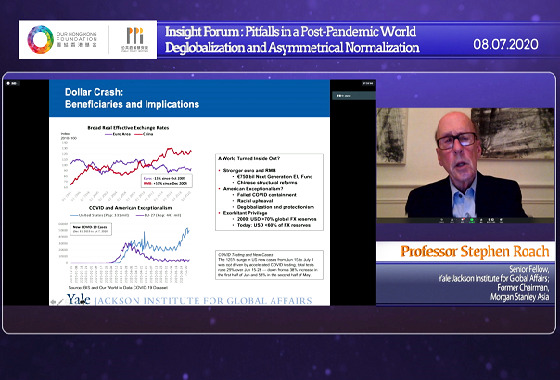
(8 July 2020, Hong Kong) While governments contemplate or implement the exiting of Covid-19 lockdowns and the reopening of stalled economies, an early stage of asymmetrical normalization is apparent. Meanwhile, the global shortage of medical supplies during the early stages of outbreak has stoked concerns over supply chain security and triggered assertive nationalism. The Our Hong Kong Foundation (OHKF) today organised the fifth session of ‘INSIGHT FORUM’ with Professor Stephen Roach, Senior Fellow at Yale Jackson Institute for Global Affairs, who shared his expert insights on the pitfalls of the post-pandemic turmoil, how reshoring calls might reverse globalization, and the odds of a crash in the US Dollar.
Asymmetrical Normalization Apparent as Covid-19 Restrictions Are Lifted
As governments around the world ease Covid-19 lockdown restrictions, an early stage of asymmetrical normalization is apparent, said Professor Roach. As in the case of China, kick-starting production is found to be easier than boosting consumer demand, particularly eliciting a quick revival of face-to-face services amid fears of a coronavirus resurgence. Professor Roach noted that consumer retrenchment will likely persist until a Covid-19 vaccine arrives. Meanwhile, recovery is uneven in the US, where the economy remains fragile while trying to exit lockdowns amid a virus resurgence. Roach added that if the US does not deal with the virus forcefully, the health and economic problems in the US will likely continue for longer.
China-US Decoupling Could Come with Serious Consequences
From trade conflicts to the struggles to contain the coronavirus pandemic, US-China relations are on the brink of a major rupture. Professor Roach said the world’s largest economies are bound for an economic decoupling from their embedded codependency. Significantly, China remains America’s largest importer, an important outgrowth of a massive shortfall of domestic saving, that is likely to go from bad to worse in the face of exploding Federal government budget deficits. That will spark a record current account deficit and contribute to a sharp fall in the US dollar, which could lead to great financial instability. Both countries need to comprehend what’s at stake and seize the opportunity to avert a full rupture that comes with serious economic and geopolitical consequences.
Covid-19 Supply Shocks and Resultant Reshoring May Unwind Trade Liberalization
The global scramble for medical supplies during the outbreak of Covid-19 has raised concerns among countries about supply chain security, with rising calls for reshoring to bring supply chains back home. Professor Roach believed too much slack may have been taken out of global supply chains with not much redundancy to deal with the pandemic. But that hardly justifies substantial reshoring, which would lead to higher costs for producers and consumers and threaten to unwind the dramatic trade liberalization that occurred after the World War II. Nonetheless, he stressed that supply chains should be made more flexible to deal with future supply shocks.
Doubts Over American Exceptionalism May Hasten the Fall of the US Dollar
Professor Roach warned that the dollar would also be threatened by growing doubts the world is having about so-called American exceptionalism. It’s not just budget and current account deficits but also America’s efforts to lead the way in de-globalization, decoupling, and protectionism—to say nothing of abject failures at Covid containment and an historic outbreak of racial unrest. For the first time in the post-World War II era, the hegemon is in serious trouble.
‘Pitfalls in a Post-Pandemic World: Deglobalization and Asymmetrical Normalization’:
https://youtu.be/JzjxuXKCvH4
%20800.png)
%20800.png)


(8 July 2020, Hong Kong) While governments contemplate or implement the exiting of Covid-19 lockdowns and the reopening of stalled economies, an early stage of asymmetrical normalization is apparent. Meanwhile, the global shortage of medical supplies during the early stages of outbreak has stoked concerns over supply chain security and triggered assertive nationalism. The Our Hong Kong Foundation (OHKF) today organised the fifth session of ‘INSIGHT FORUM’ with Professor Stephen Roach, Senior Fellow at Yale Jackson Institute for Global Affairs, who shared his expert insights on the pitfalls of the post-pandemic turmoil, how reshoring calls might reverse globalization, and the odds of a crash in the US Dollar.
Asymmetrical Normalization Apparent as Covid-19 Restrictions Are Lifted
As governments around the world ease Covid-19 lockdown restrictions, an early stage of asymmetrical normalization is apparent, said Professor Roach. As in the case of China, kick-starting production is found to be easier than boosting consumer demand, particularly eliciting a quick revival of face-to-face services amid fears of a coronavirus resurgence. Professor Roach noted that consumer retrenchment will likely persist until a Covid-19 vaccine arrives. Meanwhile, recovery is uneven in the US, where the economy remains fragile while trying to exit lockdowns amid a virus resurgence. Roach added that if the US does not deal with the virus forcefully, the health and economic problems in the US will likely continue for longer.
China-US Decoupling Could Come with Serious Consequences
From trade conflicts to the struggles to contain the coronavirus pandemic, US-China relations are on the brink of a major rupture. Professor Roach said the world’s largest economies are bound for an economic decoupling from their embedded codependency. Significantly, China remains America’s largest importer, an important outgrowth of a massive shortfall of domestic saving, that is likely to go from bad to worse in the face of exploding Federal government budget deficits. That will spark a record current account deficit and contribute to a sharp fall in the US dollar, which could lead to great financial instability. Both countries need to comprehend what’s at stake and seize the opportunity to avert a full rupture that comes with serious economic and geopolitical consequences.
Covid-19 Supply Shocks and Resultant Reshoring May Unwind Trade Liberalization
The global scramble for medical supplies during the outbreak of Covid-19 has raised concerns among countries about supply chain security, with rising calls for reshoring to bring supply chains back home. Professor Roach believed too much slack may have been taken out of global supply chains with not much redundancy to deal with the pandemic. But that hardly justifies substantial reshoring, which would lead to higher costs for producers and consumers and threaten to unwind the dramatic trade liberalization that occurred after the World War II. Nonetheless, he stressed that supply chains should be made more flexible to deal with future supply shocks.
Doubts Over American Exceptionalism May Hasten the Fall of the US Dollar
Professor Roach warned that the dollar would also be threatened by growing doubts the world is having about so-called American exceptionalism. It’s not just budget and current account deficits but also America’s efforts to lead the way in de-globalization, decoupling, and protectionism—to say nothing of abject failures at Covid containment and an historic outbreak of racial unrest. For the first time in the post-World War II era, the hegemon is in serious trouble.
‘Pitfalls in a Post-Pandemic World: Deglobalization and Asymmetrical Normalization’:
https://youtu.be/JzjxuXKCvH4