










Cabin hospital proves the construction efficiency of MiC




Cabin hospital proves the construction efficiency of MiC

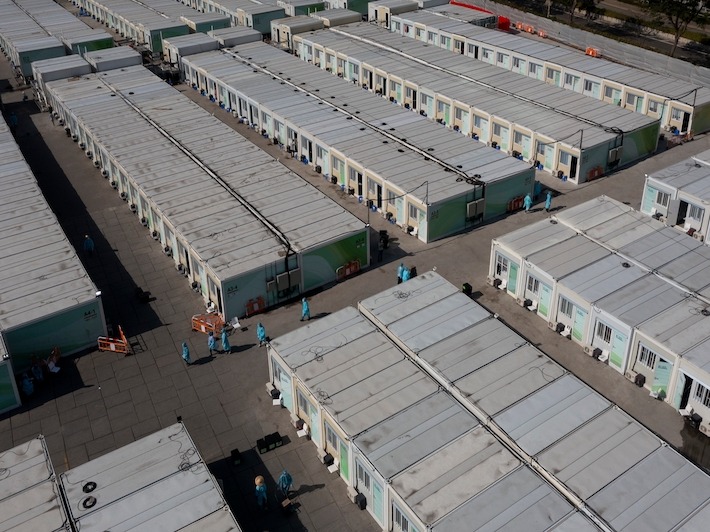
The onslaught of the 5th wave of Covid-19 in Hong Kong has sparked a dramatic surge in the number of severe cases and isolation orders, overwhelming the healthcare system with hospitals running out of beds. Fortunately, the first community isolation facility, sometimes referred to as a mobile cabin hospital, in Tsing Yi was completed in only 7 days, providing 3,900 beds for the isolation of asymptomatic and mild cases. This slightly alleviates the pressure on the medical system.
Just as God created the world in 7 days, the Government put up the mobile cabin hospital in an equally short time with the aid of Modular Integrated Construction (MiC). After free-standing integrated modules were mass-produced in a prefabrication factory, they were transported to the site for direct assembly, greatly enhancing construction efficiency. The swift provision of 3,900 beds demonstrates the upside of MiC in saving plenty of construction time.
Construction time cut greatly using MiC
Some architects reckon that the products of MiC are not decent and delicate enough from the aesthetic point of view. It is thus eschewed by private developers lest the properties would be underpriced. In fact, MiC buildings come in a variety of styles. The low production cost of transitional housing projects creates an illusion that MiC is only applicable to low-end construction. MiC can indeed be used to construct alluring buildings, such as InnoCell, a smart-living and co-creation space situated in the Hong Kong Science Park. It is fully equipped with the desirable amenities of an upmarket hotel to draw local and overseas I&T talent. The construction took only 18 months, 14 months faster than conventional construction and cost 7% less.
Currently, prefabricated modules are becoming more prevalent in the construction industry, especially for public housing. MiC goes further as to using integrated modules (completed with finishes, fixtures and fittings) so that they can be directly installed on-site after being transported from the Mainland factories. Like how Lego works, MiC greatly compresses construction time, boosts construction quality and reduces work injury.
Cost concern of adopting MiC
Unquestionably, the most practical concern over fully implementing MiC is the cost. For instance, as MiC is done unit by unit, two walls exist between adjacent units, diminishing the saleable area. Despite 6% additional floor area being granted by the Government to MiC projects since 2019, it may not sufficiently offset the loss in the saleable area. In view of this, the 2022-23 Budget mentions increasing the concession of floor area from the current 6% to 10% in a bid to encourage the adoption of MiC.
Besides, multiple technical issues have to be fixed before the full implementation of MiC, including but not limited to project planning, manufacturing, quality control, transportation and site limitations, all of which require new regulations, innovative techniques and experience. Take project planning as an example, in order to adopt MiC, developers have to finalise the layout of the building at a very early stage. It also involves tedious coordination of the entire supply chain and logistics planning, which in effect reduces the room for design adjustments during the construction period in response to changes in the real estate market.
Local prefabrication factories are preferable
Currently, modules used for MiC are mostly manufactured on the Mainland. Developers need to arrange for professionals to supervise the design and manufacturing in the factories, requiring extra manpower and time with additional cost and reduced flexibility. Should more construction projects adopt MiC in the future, a larger pool of professionals and manual workers is needed. Given the irregular execution schedules of large-scale projects, the industry is alternately faced with the problems of insufficient manpower and excessive labour. As such, the whole industry needs to be reformed and upgraded to ensure a steady demand for and supply of human resources. Establishing local MiC factories is one of the viable solutions. While the Government is currently studying the feasibility of reclamation at Lung Kwu Tan, a large-scale industrial park can be established there to construct prefabrication factories, fostering the transformation of the traditional construction industry.
Other obstacles to the application of MiC include the transportation of large modules and the restrictively small area for on-site assembly. Therefore, MiC is more applicable to new development areas with relatively fewer limitations on roads and sites. To facilitate the development of the Northern Metropolis, prompt actions should be taken to establish a new system, offer vocational training, transform the industry and construct local prefabrication factories.


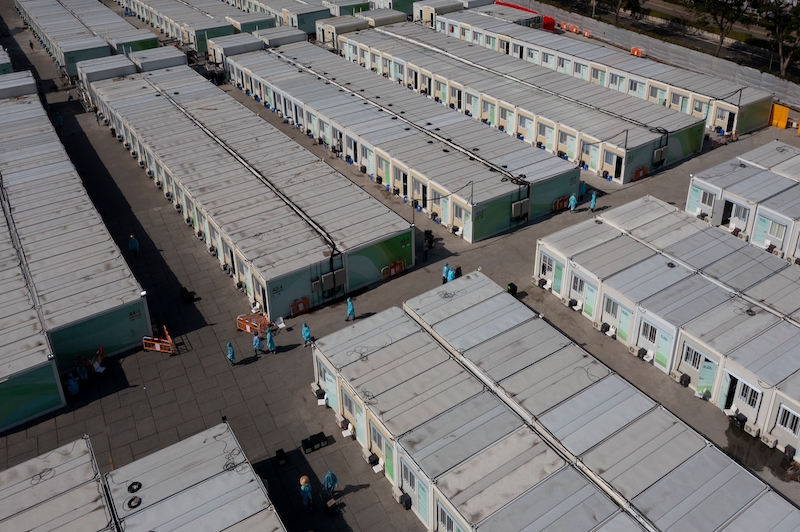
The onslaught of the 5th wave of Covid-19 in Hong Kong has sparked a dramatic surge in the number of severe cases and isolation orders, overwhelming the healthcare system with hospitals running out of beds. Fortunately, the first community isolation facility, sometimes referred to as a mobile cabin hospital, in Tsing Yi was completed in only 7 days, providing 3,900 beds for the isolation of asymptomatic and mild cases. This slightly alleviates the pressure on the medical system.
Just as God created the world in 7 days, the Government put up the mobile cabin hospital in an equally short time with the aid of Modular Integrated Construction (MiC). After free-standing integrated modules were mass-produced in a prefabrication factory, they were transported to the site for direct assembly, greatly enhancing construction efficiency. The swift provision of 3,900 beds demonstrates the upside of MiC in saving plenty of construction time.
Construction time cut greatly using MiC
Some architects reckon that the products of MiC are not decent and delicate enough from the aesthetic point of view. It is thus eschewed by private developers lest the properties would be underpriced. In fact, MiC buildings come in a variety of styles. The low production cost of transitional housing projects creates an illusion that MiC is only applicable to low-end construction. MiC can indeed be used to construct alluring buildings, such as InnoCell, a smart-living and co-creation space situated in the Hong Kong Science Park. It is fully equipped with the desirable amenities of an upmarket hotel to draw local and overseas I&T talent. The construction took only 18 months, 14 months faster than conventional construction and cost 7% less.
Currently, prefabricated modules are becoming more prevalent in the construction industry, especially for public housing. MiC goes further as to using integrated modules (completed with finishes, fixtures and fittings) so that they can be directly installed on-site after being transported from the Mainland factories. Like how Lego works, MiC greatly compresses construction time, boosts construction quality and reduces work injury.
Cost concern of adopting MiC
Unquestionably, the most practical concern over fully implementing MiC is the cost. For instance, as MiC is done unit by unit, two walls exist between adjacent units, diminishing the saleable area. Despite 6% additional floor area being granted by the Government to MiC projects since 2019, it may not sufficiently offset the loss in the saleable area. In view of this, the 2022-23 Budget mentions increasing the concession of floor area from the current 6% to 10% in a bid to encourage the adoption of MiC.
Besides, multiple technical issues have to be fixed before the full implementation of MiC, including but not limited to project planning, manufacturing, quality control, transportation and site limitations, all of which require new regulations, innovative techniques and experience. Take project planning as an example, in order to adopt MiC, developers have to finalise the layout of the building at a very early stage. It also involves tedious coordination of the entire supply chain and logistics planning, which in effect reduces the room for design adjustments during the construction period in response to changes in the real estate market.
Local prefabrication factories are preferable
Currently, modules used for MiC are mostly manufactured on the Mainland. Developers need to arrange for professionals to supervise the design and manufacturing in the factories, requiring extra manpower and time with additional cost and reduced flexibility. Should more construction projects adopt MiC in the future, a larger pool of professionals and manual workers is needed. Given the irregular execution schedules of large-scale projects, the industry is alternately faced with the problems of insufficient manpower and excessive labour. As such, the whole industry needs to be reformed and upgraded to ensure a steady demand for and supply of human resources. Establishing local MiC factories is one of the viable solutions. While the Government is currently studying the feasibility of reclamation at Lung Kwu Tan, a large-scale industrial park can be established there to construct prefabrication factories, fostering the transformation of the traditional construction industry.
Other obstacles to the application of MiC include the transportation of large modules and the restrictively small area for on-site assembly. Therefore, MiC is more applicable to new development areas with relatively fewer limitations on roads and sites. To facilitate the development of the Northern Metropolis, prompt actions should be taken to establish a new system, offer vocational training, transform the industry and construct local prefabrication factories.