






Leverage the Greater Bay Area for the arts




Leverage the Greater Bay Area for the arts

Authors: Helen So, Researcher for Arts Innovation at Our Hong Kong Foundation and member of the Advisory Committee on Arts Development, and Corliss Chan, Intern Researcher for Arts Innovation at Our Hong Kong Foundation
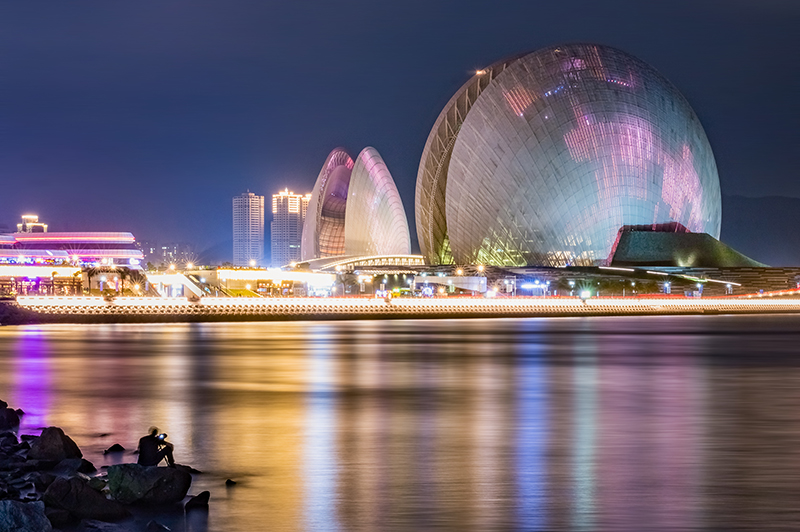
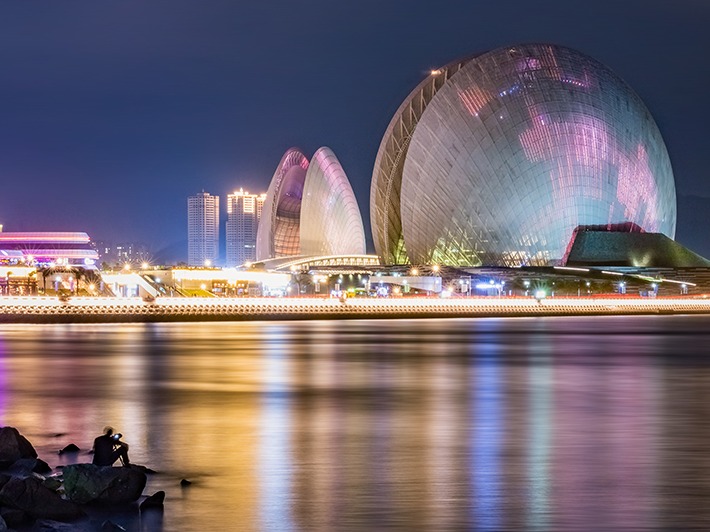
The Zhuhai Grand Theatre
The buzz of the Greater Bay Area project, a government scheme to link up Hong Kong and other Chinese cities in a business hub, has spilled over into the arts and culture. Last month, a festival organised by the Hong Kong Celebrations Association in Victoria Park, featuring Belgian DJ DVLM and K-pop idol Rain and well attended by youngsters, was called the Greater Bay Festival even though it appeared to have little to do with the business park. However, this may be reflective of the intention to further develop the arts in the Greater Bay Area.
In June, the Guangdong-Hong Kong-Macau Greater Bay Area Culture and Arts Festival was inaugurated, the intentional fruit of a work plan between the Guangdong and Hong Kong governments. This performing arts festival, identified by Chief Executive Carrie Lam Cheng Yuet-ngor as one of nine major outcomes of the work plan, corrals together regional resources to foster cultural exchange. So far, it has brought together the Chinese Opera Festival and the Xiqu Centre in West Kowloon Cultural District. It has also helped the Guangzhou Opera House to partner with Hong Kong theatre group Actors’ Family to produce the musical The Lily of the Valley.
In 2018, the Hong Kong government introduced HK$140 million (US$18 million) in funding over five years to support local artists in their cultural exchanges in the Greater Bay Area. Around 20 local productions have been put up, with more in the pipeline. Reviews of the scheme have generally been positive, although whether this funding will continue after 2023 remains a mystery.
That Hong Kong’s programmes still have an edge in the region is a sentiment that resonates with many local veteran arts administrators and cultural thought leaders; but they also say that is “only while the opportunity lasts”.
Fans of Hong Kong’s productions like the authenticity and originality of the performances and themes. At this year’s 2nd Chinese Theatre Awards, the Chinese equivalent of the Tony Awards, the Hong Kong Repertory Theatre swept six out of the 14 awards, including best director, best producer and best playwright.
Hong Kong’s rapid development and unique history “lends itself to works that offer fresh, unthought-of perspectives that are more innovative and original than those of its regional counterparts,” said a Foshan-based radio DJ about a Hong Kong production in his hometown. “We like that they are embedded with rich Hong Kong local characteristics.”
Clearly, across the Cantonese-speaking regions, Hong Kong’s productions are popular and a driving artistic force. It is in everyone’s interests to keep up cultural exchanges and sustain the development of the arts.
Disappointingly, the government seems to be taking an event-based approach to such exchanges, organising one-off collaborations or performance opportunities. Once troupes return, there is little follow-up, and the ability and incentive to independently maintain and deepen cultural diplomacy and exchange is lost.
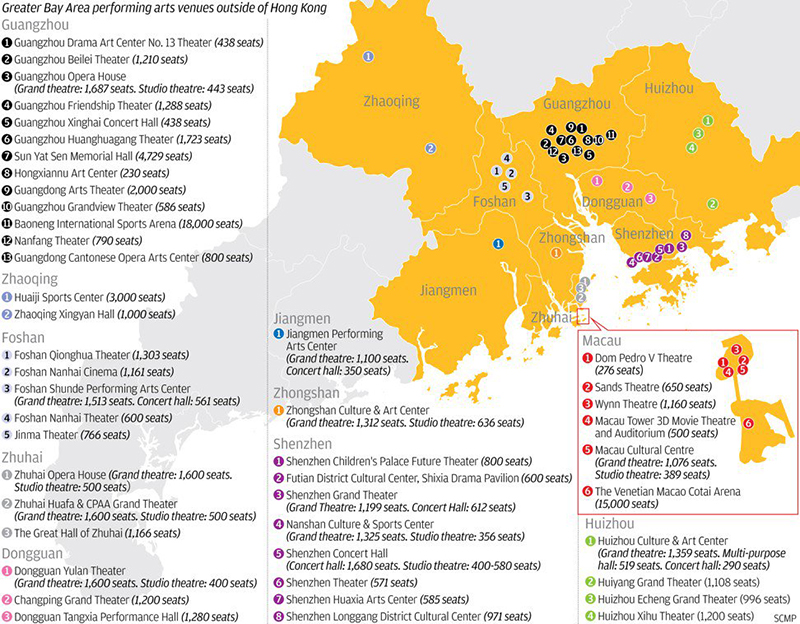
Greater Bay Area performing arts venues outside of Hong Kong
There is a critical need to maximise resources for better, more sustainable outcomes, and one way is to develop the institutions that encourage collaboration. The government could, for example, negotiate more farsighted partnerships with private companies, forming sister partnerships or market-driven alliances focused on Greater Bay Area performing arts venues, performing arts groups, as well as the links that bind them. These important infrastructures help industry players to keep up with developments and allow collaborations to happen organically and more sustainably.
Chances are, come 2023, when the pilot funding of HK$140 million runs out, it will be replenished. And the performing arts industry will not say no to additional support.
In the interim, the Hong Kong government ought to put the money to better, more farsighted use to maximise the intended effect of the policy. This will help to build a larger, more self-sustainable arts and cultural ecosystem that drives itself and the region forward.


Authors: Helen So, Researcher for Arts Innovation at Our Hong Kong Foundation and member of the Advisory Committee on Arts Development, and Corliss Chan, Intern Researcher for Arts Innovation at Our Hong Kong Foundation
The Zhuhai Grand Theatre
The buzz of the Greater Bay Area project, a government scheme to link up Hong Kong and other Chinese cities in a business hub, has spilled over into the arts and culture. Last month, a festival organised by the Hong Kong Celebrations Association in Victoria Park, featuring Belgian DJ DVLM and K-pop idol Rain and well attended by youngsters, was called the Greater Bay Festival even though it appeared to have little to do with the business park. However, this may be reflective of the intention to further develop the arts in the Greater Bay Area.
In June, the Guangdong-Hong Kong-Macau Greater Bay Area Culture and Arts Festival was inaugurated, the intentional fruit of a work plan between the Guangdong and Hong Kong governments. This performing arts festival, identified by Chief Executive Carrie Lam Cheng Yuet-ngor as one of nine major outcomes of the work plan, corrals together regional resources to foster cultural exchange. So far, it has brought together the Chinese Opera Festival and the Xiqu Centre in West Kowloon Cultural District. It has also helped the Guangzhou Opera House to partner with Hong Kong theatre group Actors’ Family to produce the musical The Lily of the Valley.
In 2018, the Hong Kong government introduced HK$140 million (US$18 million) in funding over five years to support local artists in their cultural exchanges in the Greater Bay Area. Around 20 local productions have been put up, with more in the pipeline. Reviews of the scheme have generally been positive, although whether this funding will continue after 2023 remains a mystery.
That Hong Kong’s programmes still have an edge in the region is a sentiment that resonates with many local veteran arts administrators and cultural thought leaders; but they also say that is “only while the opportunity lasts”.
Fans of Hong Kong’s productions like the authenticity and originality of the performances and themes. At this year’s 2nd Chinese Theatre Awards, the Chinese equivalent of the Tony Awards, the Hong Kong Repertory Theatre swept six out of the 14 awards, including best director, best producer and best playwright.
Hong Kong’s rapid development and unique history “lends itself to works that offer fresh, unthought-of perspectives that are more innovative and original than those of its regional counterparts,” said a Foshan-based radio DJ about a Hong Kong production in his hometown. “We like that they are embedded with rich Hong Kong local characteristics.”
Clearly, across the Cantonese-speaking regions, Hong Kong’s productions are popular and a driving artistic force. It is in everyone’s interests to keep up cultural exchanges and sustain the development of the arts.
Disappointingly, the government seems to be taking an event-based approach to such exchanges, organising one-off collaborations or performance opportunities. Once troupes return, there is little follow-up, and the ability and incentive to independently maintain and deepen cultural diplomacy and exchange is lost.
Greater Bay Area performing arts venues outside of Hong Kong
There is a critical need to maximise resources for better, more sustainable outcomes, and one way is to develop the institutions that encourage collaboration. The government could, for example, negotiate more farsighted partnerships with private companies, forming sister partnerships or market-driven alliances focused on Greater Bay Area performing arts venues, performing arts groups, as well as the links that bind them. These important infrastructures help industry players to keep up with developments and allow collaborations to happen organically and more sustainably.
Chances are, come 2023, when the pilot funding of HK$140 million runs out, it will be replenished. And the performing arts industry will not say no to additional support.
In the interim, the Hong Kong government ought to put the money to better, more farsighted use to maximise the intended effect of the policy. This will help to build a larger, more self-sustainable arts and cultural ecosystem that drives itself and the region forward.